


Updated 6 days ago
Coffee Packaging for Retail Display: Match Your Pack to How Customers Shop
Cyan Pak Coffee
At Cyan Pak Coffee, we provide professional coffee packaging solutions for roasters, cafés, and beverage brands. From design and printing to production and delivery, our team offers a full range of custom packaging services. Our products include coffee bags, boxes, takeaway cups, and other packaging accessories, all customizable in materials, sizes, and print finishes. Focusing on sustainability, innovative design, and low minimum orders, we help brands create unique and efficient packaging experiences.

Coffee Packaging For Retail Display
Coffee Packaging For Retail Display is required to operate out of a environment that's not completely within the control of the brand. Bags sit next to other coffees, shelf edges can obscure lower info, and shoppers do research on a few coffees before grabbing one. What might seem like a clear design when it comes to a photo in the studio can be tricky when placed in a busy shop.
For brands that are introducing their coffee into cafés, specialty coffee, or grocery retail, it is a matter of creating a balance between the physical pack and the buying experience. All these shape, information, color, and handling contribute.
The most helpful design review, then, begins at the shelf and then guides the customer through his or her recognition, comparison and selection processes.
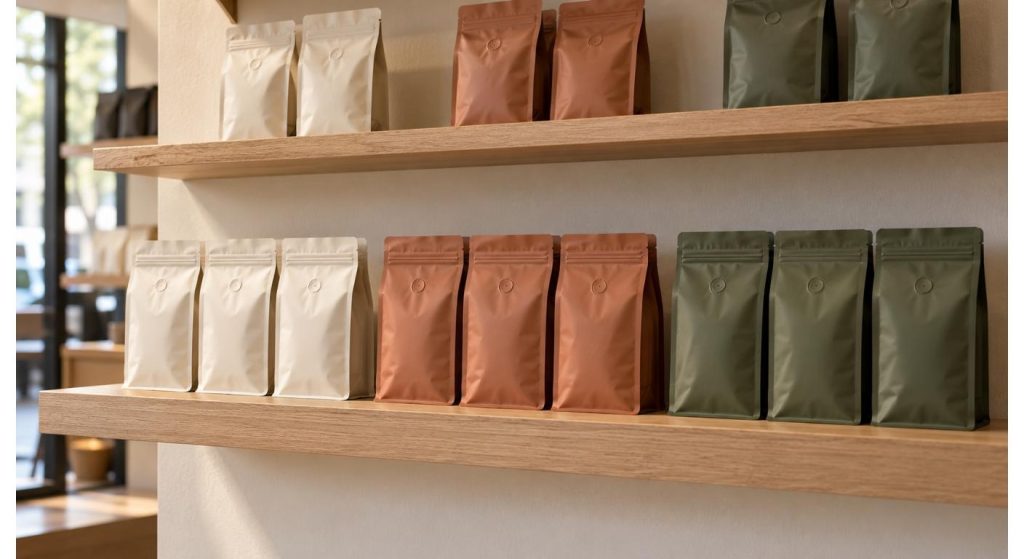
The most important step of packaging is to read the display.
Start by considering the desired retail setting. Whatever you need to do to get a sense of the size of the shelf and pictures of the products that will be around the proposed location. There are different constraints between a cafe counter, an eye level grocery shelf and a narrow wall display.
Determine available height, depth and usable width. When considering customer visibility, take the following into account: shelf lips, price strips, dividers, and overhead clearance.
Take into account the way the product is organised by staff. Some shops have one pack facing forward, stocked behind it and others have multiple coffees side by side. These layouts can be different from the same bag size.
Use these observations to set up the design brief. Packaging should be appropriate to the agreed 'space' and provide useful information without staff needing to update the packaging after each customer interaction.
| Planning Item | Calculation | Practical Note |
| Maximum front facings | Usable shelf width ÷ filled bag width | Round down and allow handling clearance |
| Packs per facing | Usable shelf depth ÷ filled bag depth | Round down; verify physical fit |
| Nominal shelf stock | Front facings × packs per facing | Confirm with filled samples |
| Vertical clearance | Clear shelf height − filled bag height | Leave room for easy removal |
Pick a Bag that looks good when it's full.
The base and proportions determine if a bag is going to stand up and have its front panel exposed. Test those attributes with the coffee itself.
Cyan Pak's flat bottom pouches provide structure and flexibility in size for retail display. These should be evaluated if a specific forms of standing shape is desired to fit a specific form of display.
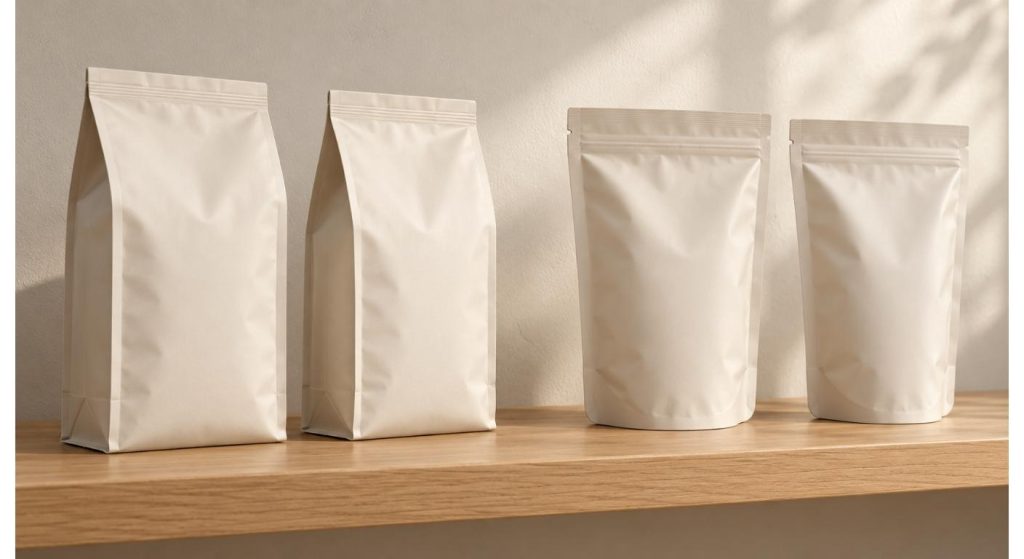
Its stand up coffee pouches offer a different stand-up alternative, offering a variety of material, print and feature options. Propose dimensions and stances that are filled up instead of just matching name of format.
Put selected samples into proposed shelf position. Look to see if they are leaning on other packs, if they are exceeding the allotted width or if they are invisible underneath the shelf above. If a row is partially sold, the presentation should still be usable – it shouldn't just be when the display is first set up.
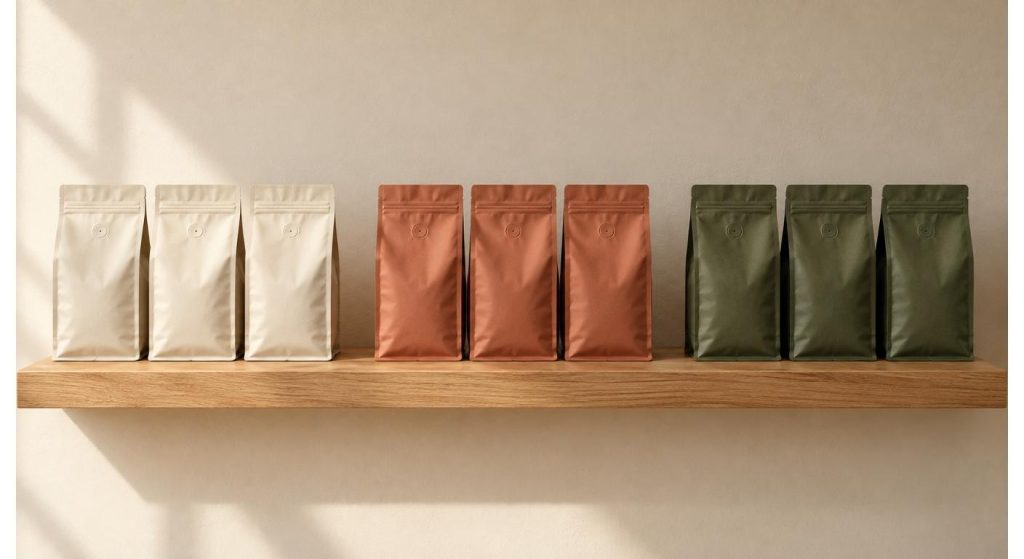
Read the Front Panel from Left to Right
The front should convey to a customer which coffee they are viewing and communicate the brand. Determine what is important to acknowledge and what are the details to be clarified when the bag is collected.
Don't give the logo, origin story, tasting notes, promotional message and decorative pattern equal weight. When the product is displayed in front of the audience, if it is crowded, it will be difficult for the product to stand out even if the individual components look attractive.
Cyan Pak's branded coffee bags feature printed graphics and details. Take advantage of that freedom to provide a conscious hierarchy, instead of maximizing all the surface area.
Look at an opened pouch from a typical store. Determine if any folds, the valve or reflected light interferes with the primary message. Important information should be readily available when the bag is in its natural state and not pulled flat for viewing.
Determine Easy Ways to Make Different Coffees
If coordinating, a range should make it possible for customers to identify the brand and differentiate the products. Start with an option the shopper must choose: the type of coffee, whether roast, whole beans or ground, or some other important option.
Use the same elements throughout the program. Use readable names in addition to colour to enable the system not to be reliant on colour alone, vary selected elements to identify products.
Try out the range as a class. A design could be unique and stand out among one or two bags, but not amidst a bunch of very similar bags. Add any decaffeinated, or ground, versions to the comparison to ensure a selection of what to avoid is not made.
Make plans for future additions, too. Another origin or seasonal release should be accommodated by the visual system without having to be redesigned. When consistency is helpful to the customer, it facilitates navigation of the range.
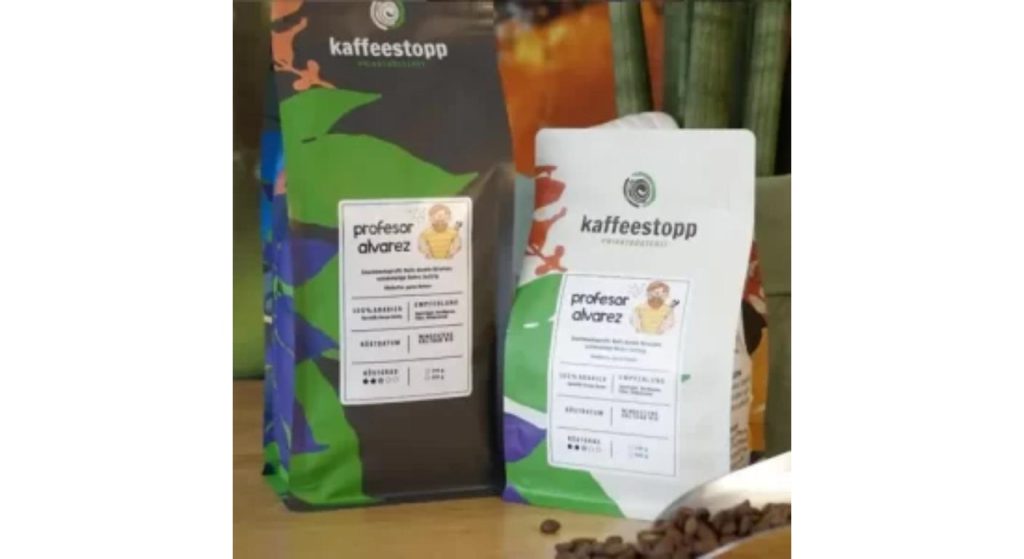
Measure Surface Finish in Normal Store Lighting Conditions
Prints can alter the way colors and details look on matte, glossy, paper-textured and other surfaces. Make a judgment of the finish that has been selected in the proposed material, not just by looking at the screen rendering.
Expose samples to the lighting to be used in the store. Look at them straight on and at an angle and see if reflections are found on the main information, as well as the smaller details.
Take routine handling into consideration as well. The bags will be taken by customers and by staff and turned/replaced. Check surface after working to make sure it looks right and not just from an unworked sample.
The packaging design service of Cyan Pak includes packaging design proposals, packaging design samples and feedback. Refine the relationship between artwork and formed bag by using the that process. A finish should afford recognizability and usability and its availability should be verified for the construction.
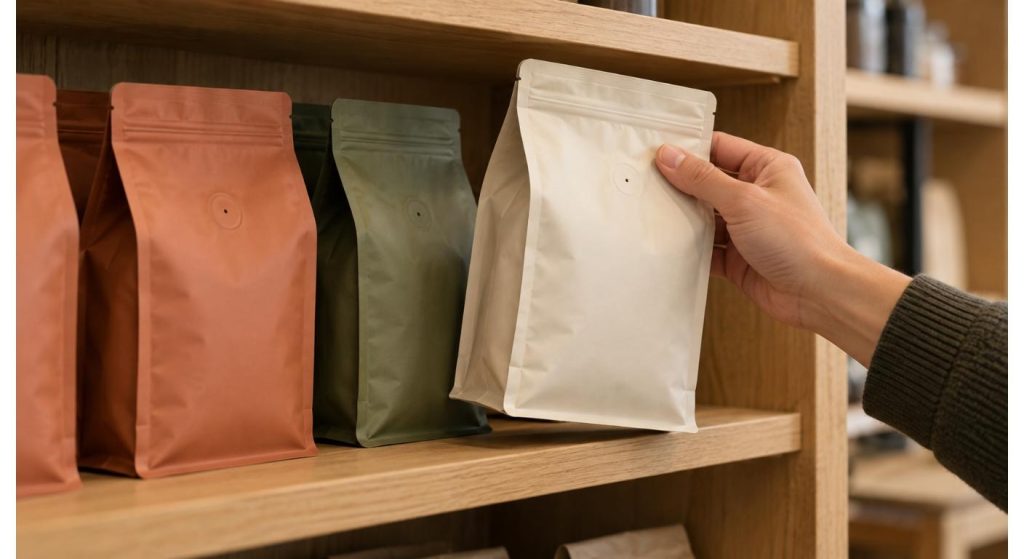
The PUPB design is an approach to designing for Pick Up, Comparison and Put Back.
Retail packaging should keep its functionality after it has caught people's interest. The customer should be able to lift the bag, find the supporting information then return the bag without breaking the display.
Describe what is in the pack in detail so that it can be easily read with the pack in hand. Minimise the placement of critical information in challenging areas and ensure the barcode is still easy to scan for the retailer.
Provide room for store applied price and/or inventory marks if necessary. Before approving artwork, agree their position, so they do not be over art identification or other information.
Encourage staff to attempt a realistic re-ordering process. Inspect the bags as they are removed from the carton, place on the shelf correctly and restock after use. This can help to identify practical issues that are not identified in a front facing mock up.
Ensure that the Display with Samples and a Retail Trial have been approved.
Coffee packaging samples from Cyan Pak can help to reduce format and material preferences. Make sure that the features are the same as the production bag you will be using a sample to approve the display.
Create a representative shelf with a variety of products from the range and the fill weights. Check complete rows and partial rows for visibility and the adjacent products that may impact visibility.
Write down items that customers or staff don't understand. Isolate packaging from other factors that influence buyers like price, shelf placement, in-stock status and promotion. You can find out how usable a system is during a brief trial but not whether or not a redesign will boost sales.
Maintain the accepted version of the shelf photographs, physical reference and artwork version together. They offer a common point of comparison when ordering a different size, or expanding to another retailer.
Conclusion
It's best to design Coffee Packaging For Retail Display with the bag as part of the shelf experience. Match the filled shape to the space, put information in a hierarchy and give product differences a clear indication. Discuss a feasible packaging design with Cyan Pak by providing your retail design and product specification requirements.
FAQs
Q1. Does it always make sense to have a flat bottom pouch for retail?
No. – Compare to other appropriate formats to be filled at same weight. The better fit depends on the dimensions, presentation and handling provided by the shelf.
Q2. Should all the details be listed on the front of a coffee bag?
No. First identify the brand and then product, then structure the other information on easy-to-access panels. Look at pouch made to see if the reading order is correct.
Q3. Does colouring suffice to differentiate the various coffees?
Label and code products in color, using names or other markings that are easily understood. Test all the range together to see if there are similarities to be confused.
Q4. Could a digital mockup be used to take the place of a shelf sample?
Represents an evaluation of the idea, but is not able to fully demonstrate standing posture, reflections or handling. Check the physical sample(s) prior to approval.
Q5. Does good shelf packaging result in increased sales?
No, sales also rely on the price, placement, availability and the demand of the customer. Consider the useability of packaging, in isolation from overall commercial results.
Written by
Cyan Pak Coffee
At Cyan Pak Coffee, we provide professional coffee packaging solutions for roasters, cafés, and beverage brands. From design and printing to production and delivery, our team offers a full range of custom packaging services. Our products include coffee bags, boxes, takeaway cups, and other packaging accessories, all customizable in materials, sizes, and print finishes. Focusing on sustainability, innovative design, and low minimum orders, we help brands create unique and efficient packaging experiences.
Related Articles

Large Capacity Coffee Packaging: Match Bulk Packs to Handling and Customer Needs
Coffee Packaging for Retail Display: Match Your Pack to How Customers Shop

Sustainable Coffee Packaging Bags: Create a Coordinated Packaging Range