


Updated 2 weeks ago
Coffee Bag Types for Roasters: Match the Bag Size, Roast Volume and Retail Channel

Cyan Pak Coffee
At Cyan Pak Coffee, we provide professional coffee packaging solutions for roasters, cafés, and beverage brands. From design and printing to production and delivery, our team offers a full range of custom packaging services. Our products include coffee bags, boxes, takeaway cups, and other packaging accessories, all customizable in materials, sizes, and print finishes. Focusing on sustainability, innovative design, and low minimum orders, we help brands create unique and efficient packaging experiences.

Coffee Bag Types for Roasters
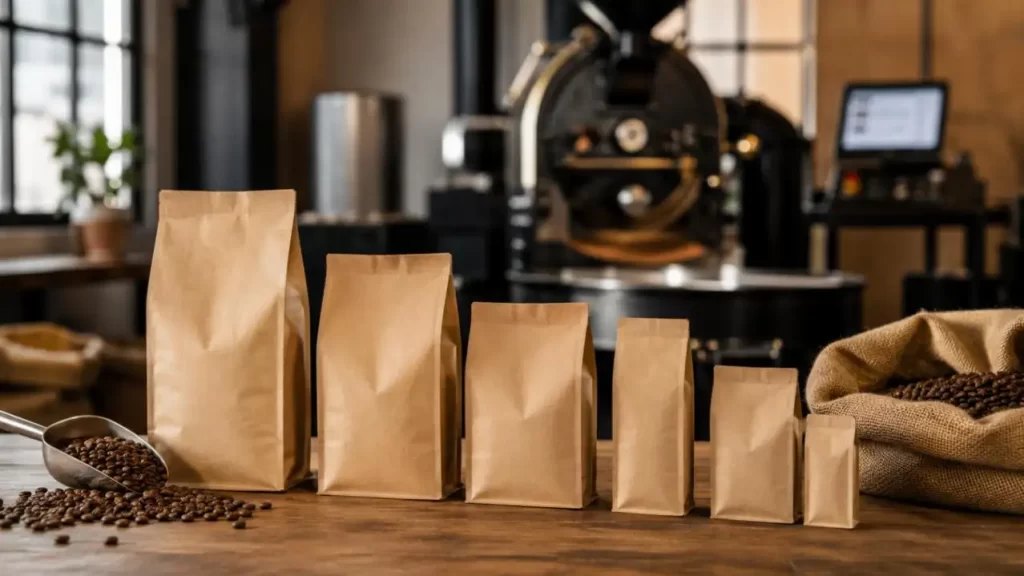
Coffee Bag Types for Roasters should be selected around the way coffee is roasted, packed, distributed and consumed—not simply around pouch appearance. A 250g specialty coffee sold through a café has different packaging priorities from a 1kg house blend supplied to foodservice customers.
For roasters, the practical selection sequence is:
Roast Volume → SKU Volume → Fill Weight → Bag Format → Sales Channel → Filling Method
Following this sequence helps avoid oversized bags, excessive packaging inventory, unsuitable valve positions and filling-line problems.
Start With Roast Volume, but Calculate Packaging by SKU
Daily or monthly roast volume provides the first indication of packaging requirements. A 10 kg/day micro-roaster may fill bags manually and operate many short-run SKUs, while a 500 kg/day operation may need standardized pouch dimensions and semi-automatic or automatic filling.
However, total roast volume should not determine bag orders on its own.
A roaster producing 3,000 kg per month might divide output between:
•House Blend: 60% of production with predictable repeat demand.
•Single-Origin Coffees: Several medium-volume SKUs with changing origins.
•Microlots: Small seasonal batches requiring shorter packaging runs.
For this reason, packaging demand is better calculated as:
Annual SKU Volume ÷ Pack Weight = Base Bag Requirement
A SKU selling 1,000 kg annually in 250g packs, for example, requires approximately 4,000 bags before safety stock, sampling, production waste and promotional demand are considered.
Coffee Bag Size Guide for Roasters
Different Coffee Bag Types for Roasters can accommodate similar fill weights, but their usable internal volume varies because gussets, base geometry, zipper placement and sealing areas consume space.
| Fill Weight | Typical Application | Common Channel | Key Design Priority |
| 50–100g | Samples, tasting sets | Subscription, events | Compact dimensions |
| 125–150g | Microlots | Specialty retail | Premium presentation |
| 227–250g | Specialty coffee | Café, retail, DTC | Shelf presence |
| 340g / 12 oz | Core retail SKU | Retail, e-commerce | Convenience |
| 500g | Household packs | Retail, DTC | Capacity + resealability |
| 1kg | Café supply | Wholesale | Filling efficiency |
| 2–5kg | Commercial supply | Foodservice | Handling + capacity |
These ranges are application references rather than fixed dimensional standards. Final bag dimensions should be verified using the actual coffee product.
Why Equal Coffee Weight Does Not Mean Equal Bag Size
One of the most important technical considerations when comparing Coffee Bag Types for Roasters is bulk volume.
A bag is specified by physical dimensions, while coffee is normally sold by weight. Those two measurements are not interchangeable.
Roast Level Changes Fill Behavior
Bean structure changes during roasting. Consequently, 250g of one roast may occupy a different volume from 250g of another.
Evaluation of bag trials should include the following:
•Actual filled height: The product must remain below the zipper and seal area.
•Headspace: Space must be available for the product to settle and for the closure and seal to occur.
•Gusset expansion: The base or side panels must completely open.
•Pack shape: Must be stable and have a presentable shape once filled.
Whole Bean and Ground Coffee Behave Differently
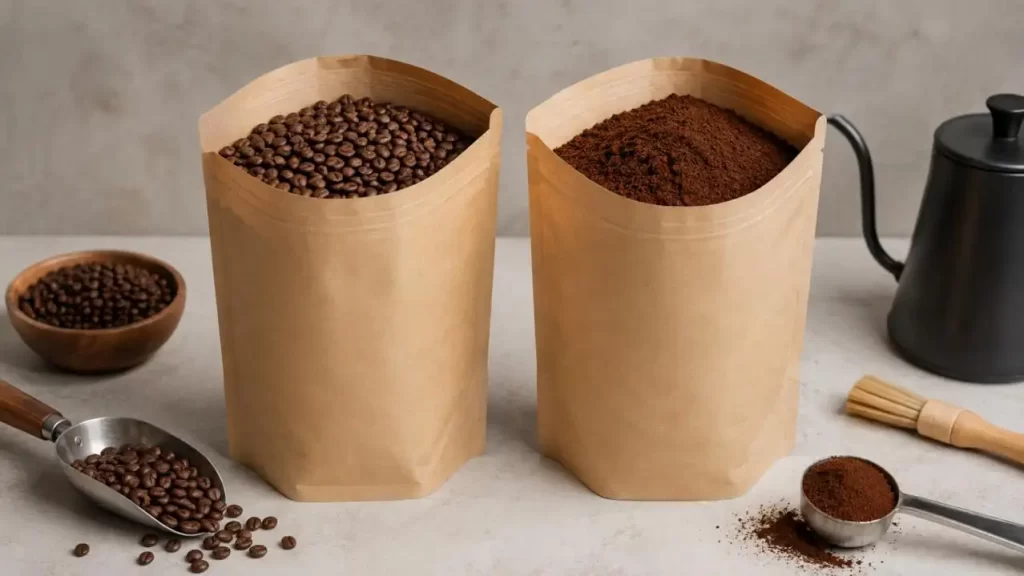
Fine particles may migrate to the seal area during the filling of ground coffee due to settle differently and pack more densely compared to whole beans.
Roasters should test whole bean and ground coffee separately, even when both products use the same nominal fill weight.
Coffee Bag Types for Roasters by Packaging Format
Stand Up Pouches
Stand up pouches can easily adjust to size for packaging ranging from 100g to 500g.
They are great for:
•Specialty coffees
•Subscription coffees
•Seasonal coffees
•Direct-to-consumer using smaller quantities
•Lower production
The empty gusset bottom expands to accommodate filling. The pouch collapses around the fill to reduce pouch volume. A flexible system makes these pouches great for these applications.
Flat Bottom Coffee Bags
Flat bottom bags use a defined base and side panels to create a more structured filled package.
They are commonly suited to:
•227g / 250g specialty packs
•340g / 12 oz retail coffee
•500g premium formats
•Multi-panel printed packaging
Their front, back, side and bottom panels provide more controlled artwork areas, while the stable base supports retail shelf presentation.
Side Gusset Coffee Bags
Side gusset bags expand laterally as coffee is filled, making them practical for larger-volume products such as 500g and 1kg packs.
They are often selected where priorities include:
•Higher fill capacity
•Café or wholesale distribution
•Efficient carton packing
•Simpler package construction
Quad Seal Bags
Quad seal formats reinforce the vertical edges of the pouch and create a defined rectangular profile.
They can be appropriate for premium retail or heavier fills where structural presentation and multiple printable panels are important.
Match Coffee Bag Types for Roasters to the Sales Channel
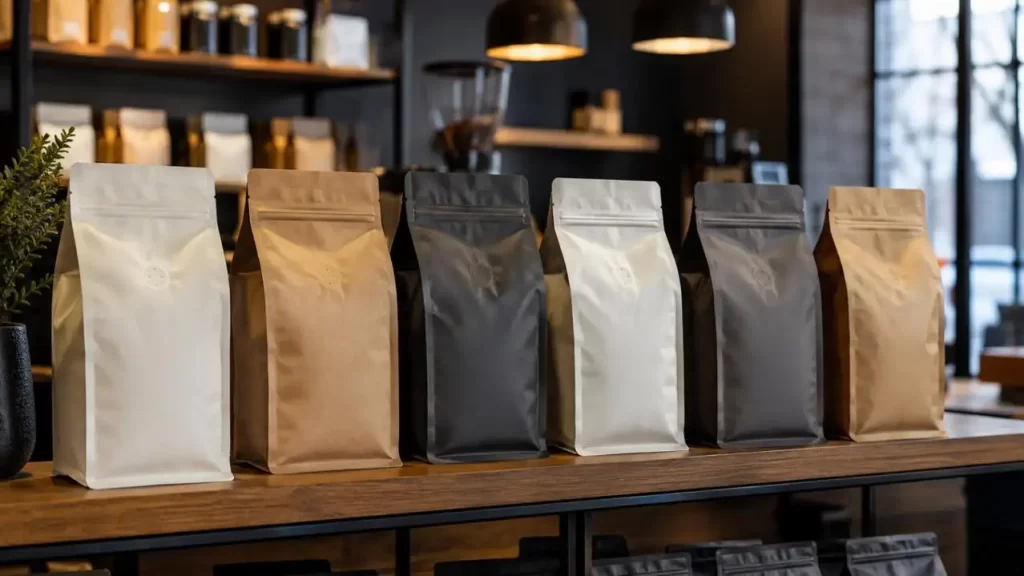
The same roaster may require several packaging formats because each channel creates different operational requirements.
| Sales Channel | Typical Pack Strategy | Suitable Formats | Main Consideration |
| Specialty Café | 200–500g | Flat Bottom, Stand Up | Display + resealability |
| Grocery Retail | 250–500g | Flat Bottom, Quad Seal | Shelf footprint |
| E-Commerce | 200–500g | Stand Up, Flat Bottom | Shipping efficiency |
| Subscription | 100–340g | Stand Up, Flat Pouch | SKU flexibility |
| Café Wholesale | 500g–1kg | Side Gusset, Quad Seal | Packing efficiency |
| Foodservice | 1–5kg | Side Gusset | Capacity + handling |
Retail coffee packaging generally requires more attention to shelf presentation, printed information and consumer closure features. Wholesale packaging places greater emphasis on fill speed, storage, carton utilization and cost per packed kilogram.
Bag Dimensions Affect Filling and Sealing
Developing Roaster Coffee Bag Types without Filling in Mind may cause problems during production later on.
Opening Width
During filling, the opening must have enough clearance for:
•Filling funnels or nozzles
•Product flow
•Mechanical grippers
•Gusset opening
Headspace and Seal Area
Coffee should not extend into the functional upper section of the pouch. Space must remain for:
•Zipper closure
•Heat sealing
•Degassing valve clearance
•Product settling
Coffee particles inside the seal area can interfere with consistent sealing, particularly with ground coffee.
Automatic Filling Compatibility
Higher-volume roasters should validate:
•Bag pickup consistency
•Pouch opening
•Filling height
•Gusset expansion
•Settling time
•Zipper position
•Sealing conditions
•Conveyor stability
A bag that performs well during manual filling may require dimensional adjustments before being introduced to an automated line.
Plan Degassing Valve Position With the Entire Bag
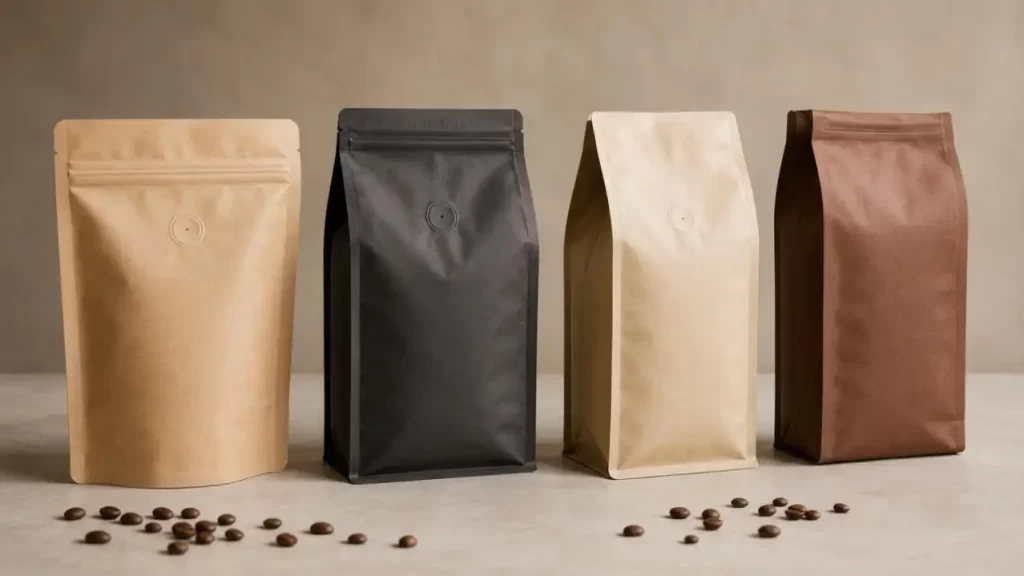
Valve placement should follow the actual filled configuration:
Bag Height → Fill Level → Headspace → Zipper → Valve Position
The valve should remain outside the primary seal area and should not interfere with zipper operation or important artwork. For this reason, valve position should be recalculated when changing from a 250g bag to a 500g or 1kg format rather than copied directly between sizes.
Stock Bags vs. Custom Printed Coffee Bags
Retained production structure predictability will influence procurement of packaging.
Stock bags are ideal for:
•New coffee launches
•Low-volume microlots
•Seasonal SKUs
•Packaging trials
•Unexpected inventory requirements
Custom printed bags are best suited for:
•Established SKUs
•Repeat retail programs
•Predictable annual demand
•Consistent branding
•Larger production runs
Cyan Pak manufactures several coffee bag options for Roasters from flat bottom to stand up and side gussets, as well as other specified dimensions, printing, barrier materials, degassing valves and zippers. This offers a packaging system that can be developed into Coffee Roaster Pack specifications based on fill weight and production needs instead of selecting standard pouches and Coffee Roaster Pack adapt to it.
A Practical Selection Framework
Before approving a coffee pouch, roasters should confirm six points:
- Calculate annual roast volume.
- Divide demand by individual SKU.
- Define the required retail fill weight.
- Identify retail, DTC, wholesale or foodservice distribution.
- Select the bag structure and functional features.
- Run actual filling, sealing, storage and carton tests.
Build the Packaging System Around the Coffee Business
The right Coffee Bag Types for Roasters are determined by the interaction between coffee volume, SKU economics, physical fill characteristics, retail channel and packing equipment.
Instead of treating 250g, 500g or 1kg as fixed pouch specifications, roasters can achieve a more reliable result by validating each format with the actual coffee and production process. For new or expanding packaging programs, Cyan Pak can work from target fill weight, roast volume, SKU structure and channel requirements to develop coffee bag specifications that support both retail presentation and day-to-day packing efficiency.
FAQs
Q1. What are the major Coffee Bag Types for Roasters?
Options typically include stand up pouches, flat bottom bags, side gusset bags, and quad seal bags. The proper format will depend on fill weight, retail channel, presentation requirements and filling equipment.
Q2. What coffee bag size is optimal for a 250g coffee pack?
A 250g bag will need to be determined after some testing of the actual coffee as the roast level, bean density, headspace, position of the zipper and bag structure can make quite a difference to the required size.
Q3. Are flat bottom bags bags recommended for specialty coffee roasters?
Yes, they are. Flat bottom bags are bags that are recommended for specialty retail coffee as they are sturdy and can have a zipper panel and degassing valve.
Q4. What is the purpose of a stand up coffee pouch for roasters?
A stand up coffee pouch is recommended for retail coffee, subscription coffee, coffee packs for different seasons, Direct Trade Coffee (DTC) and for roasters that have a broad selection of Coffee offerings and SKUs.
Q5. Are side gusset bags useful for coffee packs of 1kg?
Side gusset bags are most frequently used for 500g and 1kg coffee as they have expandable sides for additional capacity relevant for retail and trade Coffee.
Written by
Cyan Pak Coffee
At Cyan Pak Coffee, we provide professional coffee packaging solutions for roasters, cafés, and beverage brands. From design and printing to production and delivery, our team offers a full range of custom packaging services. Our products include coffee bags, boxes, takeaway cups, and other packaging accessories, all customizable in materials, sizes, and print finishes. Focusing on sustainability, innovative design, and low minimum orders, we help brands create unique and efficient packaging experiences.