


Updated 2 weeks ago
Flat Bottom Pouch for Nuts With Zipper: Why Resealable Packaging Matters

Cyan Pak Coffee
At Cyan Pak Coffee, we provide professional coffee packaging solutions for roasters, cafés, and beverage brands. From design and printing to production and delivery, our team offers a full range of custom packaging services. Our products include coffee bags, boxes, takeaway cups, and other packaging accessories, all customizable in materials, sizes, and print finishes. Focusing on sustainability, innovative design, and low minimum orders, we help brands create unique and efficient packaging experiences.

Flat Bottom Pouch for Nuts
A Flat Bottom Pouch for Nuts offers various advantages including barrier protection, pack volume, stable presentation on a shelf and an optional resealable feature. For almonds, cashews, pistachios, walnuts and mixed nuts, the resealability of the zipper becomes most valuable when the pack is intended to be consumed multiple times as opposed to being consumed right after being opened.
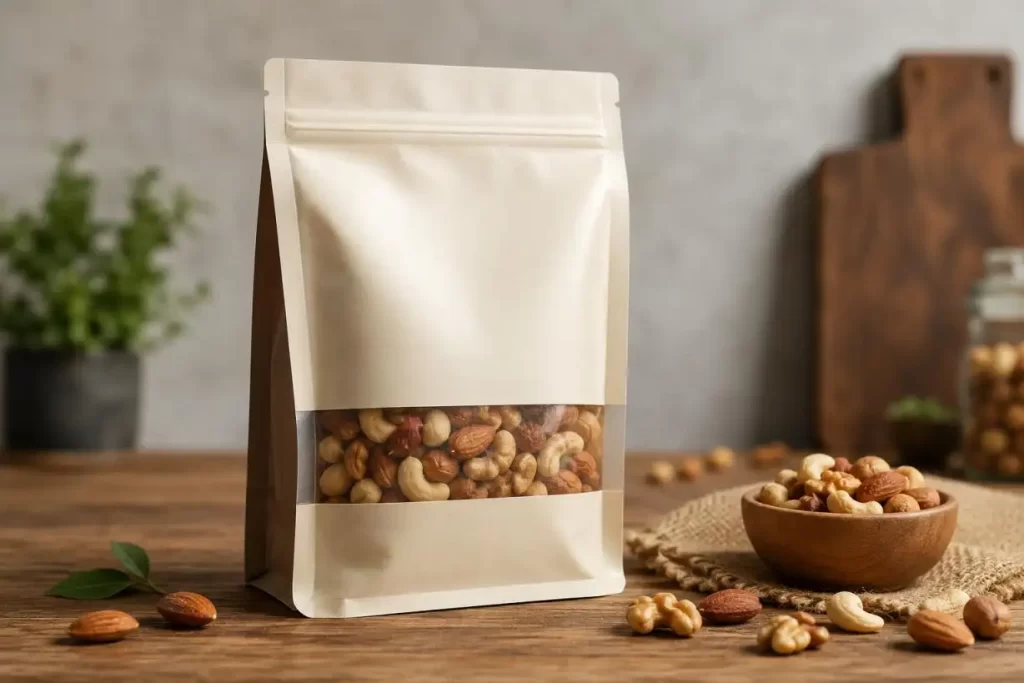
A zipper is not the primary freshness barrier for a pouch of nuts. Freshness for nuts is best achieved through 3 integrated systems.
Barrier Structure + Primary Heat Seal + Resealable Zipper
The structure of the material obstructs the flow of oxygen and moisture, the heat seal keeps the package closed, and the zipper allows the pack to be closed.
Resealability and Nut Packaging
The natural oils in nuts make them sensitive to oxygen, moisture, light and the storage environment. Once a pack of nuts has been opened the internal environment of the pack changes.
A Packaging system should consider the following:
•Oxygen exposure: Opening a pouch allows oxygen to enter the pack and introduces oxidation of the oils of the nuts along with changes in odor and flavor.
•Moisture ingress: Roasted nuts loose their crunch, if humidity enters the pack.
•Aroma transfer: The pack allows the aroma of the pack to leave, and introduces surrounding odors.
•Repeated handling: Packaging ensures that the internal environment is not in contact with external contaminates and preserved from the environment.
The benefit of a zipper generally increases with pack size. A small 30–80 g snack pouch may be consumed immediately, while 250 g, 500 g, or 1 kg packs are much more likely to require repeated closure.
Zipper, Barrier Film, and Heat Seal Perform Different Jobs
For a technically sound Flat Bottom Pouch for Nuts, these functions should be evaluated separately.
| Packaging Element | Main Function | Design Consideration |
| Barrier Film | Controls oxygen, moisture, and potentially light transmission | Match OTR/WVTR and structure to shelf-life requirements |
| Top Heat Seal | Creates the primary package closure before opening | Seal width, seal strength, contamination control |
| Zipper | Allows repeated closure after opening | Position, opening force, filling clearance |
| Pouch Structure | Contains and supports the product | Volume, gusset expansion, puncture resistance |
A zipper therefore improves reclosability, but it does not replace a suitable barrier laminate or reliable heat sealing.
How a Flat Bottom Pouch for Nuts Uses Space
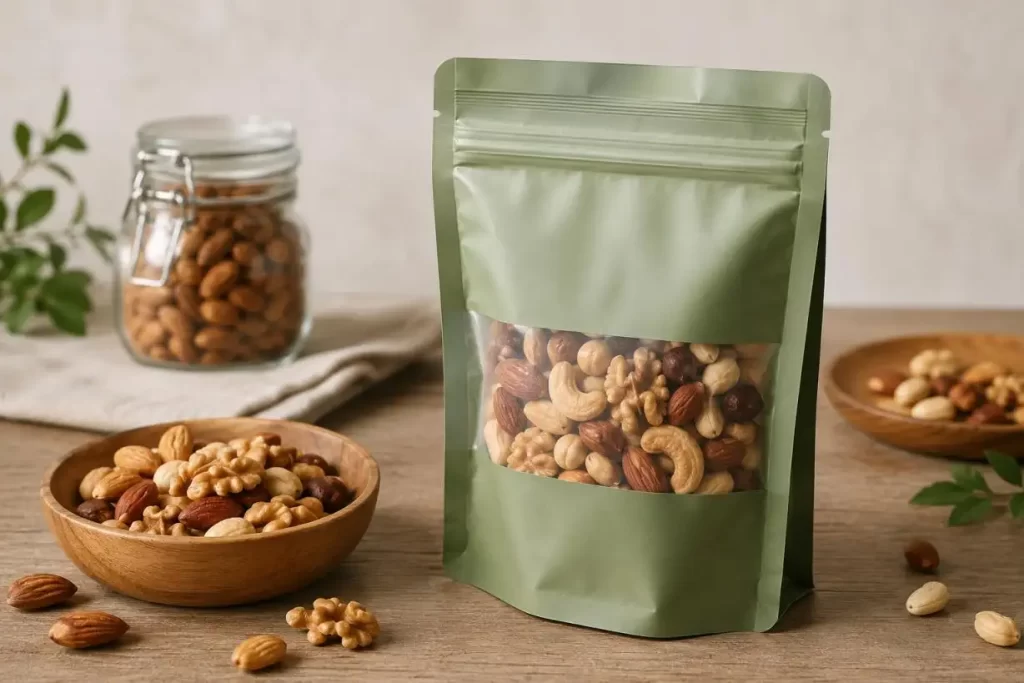
A typical Flat Bottom Pouch for Nuts consists of:
•Front and back panels
•Two expanding side gussets
•Flat bottom panel
•Top sealing area
•Optional tear notch
•Optional press-to-close zipper
Unlike a flat two-side-seal pouch, the side gussets and bottom expand after filling. This creates additional usable internal volume while maintaining a comparatively structured rectangular profile.
That geometry can be useful for nuts because product density varies substantially. The same net weight of shelled cashews and in-shell pistachios, for example, may require very different pouch dimensions.
Bag Size Should Follow Product Volume, Not Weight Alone
Before fixing pouch dimensions, buyers should evaluate:
Net Weight → Bulk Density → Required Headspace → Zipper Position → Final Bag Dimensions
Too little headspace may result in nuts or fragments reaching the zipper and sealing area. Excessive headspace, however, can produce an unnecessarily large package.
Zipper Position Is a Manufacturing Parameter
The location of the zipper affects much more than consumer convenience.
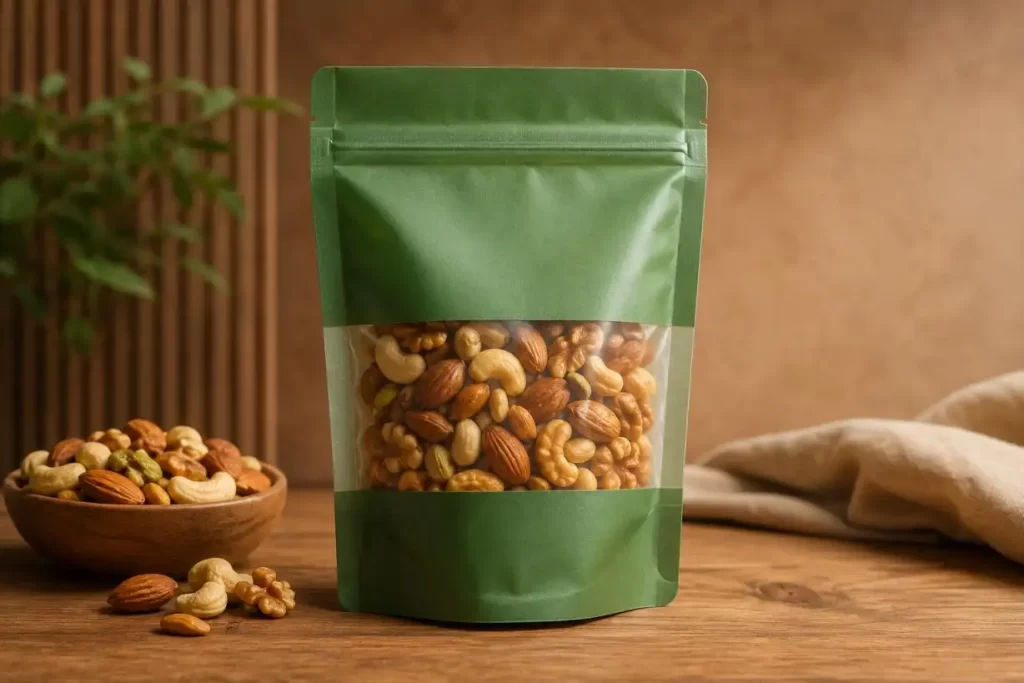
A Flat Bottom Pouch for Nuts With Zipper should provide sufficient space for:
•Filling nozzle entry
•Product flow into the pouch
•Zipper opening
•Nut settling
•Top heat sealing
•Tear notch placement
•Consumer gripping and opening
If the zipper is positioned too high, it can restrict the available heat-seal area. If it is positioned too low, it reduces usable filling volume and may interfere with graphics or product flow.
A more practical design sequence is:
Bag Height → Fill Level → Zipper Position → Top Seal → Tear Notch
This is especially important on automatic and semi-automatic filling lines.
Barrier Performance Still Determines Product Protection
A high-quality Flat Bottom Pouch for Nuts should protect against the conditions most relevant to the specific product.
| Packaging Risk | Technical Requirement |
| Oxygen-driven oxidation | Appropriate oxygen barrier / low OTR |
| Moisture-related texture change | Appropriate moisture barrier / low WVTR |
| Light-sensitive products | Opaque or light-blocking structure where required |
| Nut oils | Food-contact-compatible inner sealing layer |
| Sharp shells or pieces | Sufficient puncture and tear resistance |
| Distribution handling | Adequate seal and laminate strength |
Common Material Approaches
•PET-Based Laminates: Provide good dimensional stability, printability, and compatibility with multilayer barrier structures.
•Metallized Structures: Can be considered where stronger oxygen and light protection is required.
•PE-Based Recyclable Structures: PE-based structures can help facilitate mono-material pouch structures, but the sealing behavior, stiffness, and barrier performance need to be assessed based on the anticipated shelf life.
There is no single material structure for every Flat Bottom Pouch for Nuts. The appropriate laminate should correspond to the product, the required shelf life, the filling process, and the distribution environment.
Zipper vs. Non-Zipper Flat Bottom Pouch for Nuts
| Factor | With Zipper | Without Zipper |
| Re-closing after opening | Strong | Limited |
| Single-serving packs | Optional | Often sufficient |
| 250–500 g packs | Highly practical | Less convenient |
| Family-size packs | Strong fit | Limited after opening |
| Filling setup | Requires zipper clearance | Simpler |
| Material/converting cost | Higher | Lower |
| Consumers Storage | Easier | Requires external closure |
The Surest way to determine which option is optimal is to understand how the nuts will be consumed rather than assuming that each nut pouch needs a zipper.
Different Nuts Create Different Packaging Priorities
Almonds and Cashews
Medium and large retail packs that are consumed over several sittings provide a benefit to the inclusion of resealability and barrier protection against moisture and oxygen.
Pistachios
Consideration for gusset strength, puncture resistance and additional mechanical stresses caused by in-shell pistachios.
Walnuts
Irregular product geometry makes volume utilization, barrier performance, and handling resistance important.
Mixed Nuts
A Flat Bottom Pouch for Nuts with a zipper is particularly practical for larger mixed-nut packs that move repeatedly between the pantry and consumption environment.
Automatic Filling Compatibility Should Be Confirmed Early
For automated packing, pouch design should be checked against the actual machine rather than finalized only from artwork dimensions.
Packaging engineers should verify the following:
•Pouch pickup: Reliable separation and gripping of bags.
•Opening width: Clearance enough for the product and the filling chute.
•Gusset expansion: consistent and even gusset opening.
•Zipper clearance: Probably will not be an issue with grippers or filling components.
•Product settling: Time and distance sufficient for product settling.
•Seal cleanliness: Nut pieces and seasonings should be below the sealing area.
•Final seal position: Seal jaws must operate above the zipper without distortion.
A Flat Bottom Pouch for Nuts should therefore be designed based on the nut product and the filling system.
Sustainability Requires More Than Reducing Film
Sustainable packaging evaluation should consider the complete system:
•Total material weight
•Mono-material compatibility
•Barrier performance
•Product-to-package ratio
•Recycling route
•Protection throughout distribution
•Potential reduction in food waste
Lightweighting is valuable only when the redesigned pouch continues to protect the product adequately.
Selecting the Right Flat Bottom Pouch for Nuts
A useful procurement sequence is:
Nut Type → Net Weight and Volume → Shelf-Life Target → Barrier Requirement → Pouch Size → Zipper Design → Filling Compatibility → Printing and Sustainability
For brands developing a new Flat Bottom Pouch for Nuts, Cyan Pak can support custom pouch sizing, material and barrier selection, printing, and zipper configurations around specific product and filling requirements.
Rather than selecting the zipper as an isolated feature, packaging development works best when pouch structure, barrier performance, filling conditions, and consumer use are reviewed together. Cyan Pak can help evaluate these variables before production to develop a Flat Bottom Pouch for Nuts that fits both packaging operations and end-use requirements.
FAQs
Q1. What Nuts are Compatible with Flat Bottom Pouches with Zippers?
Flat bottom pouches design is flexible enough for snack use for almonds, cashews, pistachios, walnuts, peanuts, or any other similar snack. Pouch dimensions and material strength should be designed based on nut density and shape.
Q2. Why is the Presence of a Zipper in a Flat Bottom Pouch Design for Nuts Useful?
A zipper in a pouch design allows consumers to reclose a pouch after opening it. This feature is good to have in 250 g, 500 g, and larger bulk nut packs which are designed to be consumed in multiple sittings.
Q3. Does the Zipper Help to Keep Nuts Fresh?
The zipper in a pouch helps to keep the nuts fresh post opening the pouch, but it is not the main freshness barrier. The overall barrier required for freshness of nut packaging is made up of the combination of a barrier film, zipper, and heat seal closure.
Q4. What Barrier Properties Does Nut Packaging Require?
A flat bottom pouch design for nuts primarily controls oxygen and moisture transmission. Based on the specific product an additional barrier layer for light, puncture resistance, and oil-contact may be required.
Q5. What is the Functional Difference Between a Heat Seal and Zipper?
The heat seal is the intended primary closure for a package during the initial sale. The zipper is a flexible pouch closure for multiple openings that the consumer can adjust post initial purchase of the package.
Written by
Cyan Pak Coffee
At Cyan Pak Coffee, we provide professional coffee packaging solutions for roasters, cafés, and beverage brands. From design and printing to production and delivery, our team offers a full range of custom packaging services. Our products include coffee bags, boxes, takeaway cups, and other packaging accessories, all customizable in materials, sizes, and print finishes. Focusing on sustainability, innovative design, and low minimum orders, we help brands create unique and efficient packaging experiences.