


Updated 2 weeks ago
Flat Bottom Pouch With Degassing Valve: Valve Position and Coffee Freshness

Cyan Pak Coffee
At Cyan Pak Coffee, we provide professional coffee packaging solutions for roasters, cafés, and beverage brands. From design and printing to production and delivery, our team offers a full range of custom packaging services. Our products include coffee bags, boxes, takeaway cups, and other packaging accessories, all customizable in materials, sizes, and print finishes. Focusing on sustainability, innovative design, and low minimum orders, we help brands create unique and efficient packaging experiences.

Flat Bottom Pouch With Degassing Valve
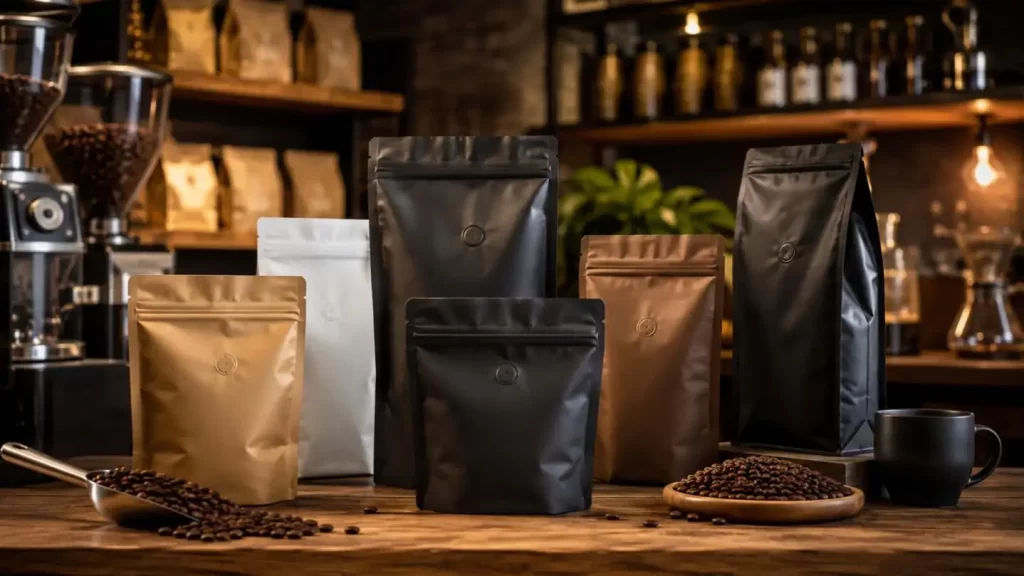
A Flat Bottom Pouch With Degassing Valve is more than a coffee bag with a one-way valve added to the front panel. For freshly roasted coffee, valve position must be coordinated with fill height, headspace, zipper location, top-seal width, barrier structure and the filling process.
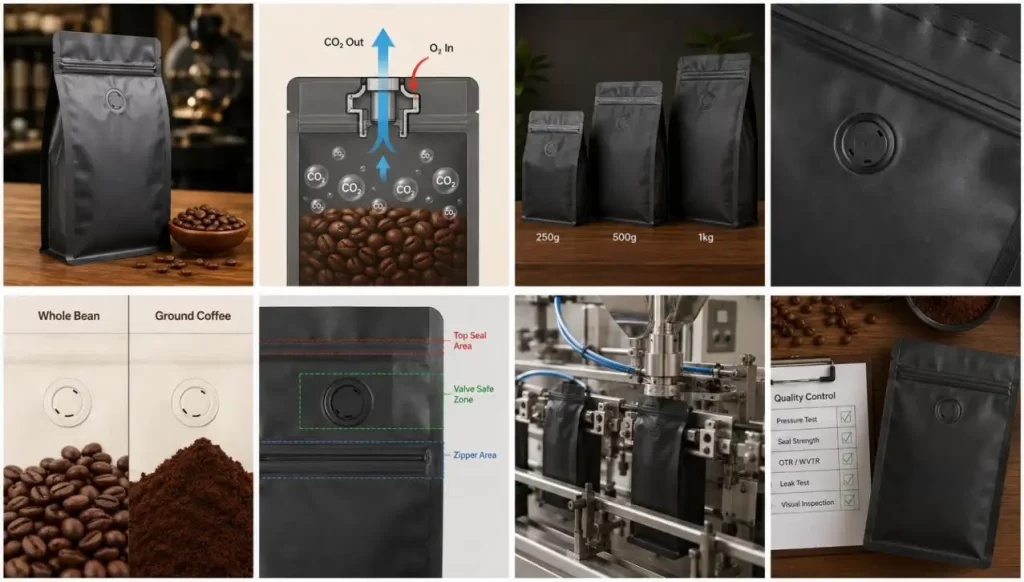
This matters because roasted coffee continues releasing CO₂ after packaging. The valve needs to vent excess internal gas while the rest of the pouch limits oxygen and moisture ingress. A poorly planned valve position can create product contact, interfere with sealing equipment or reduce usable headspace even when the valve itself functions correctly.
For this reason, Cyan Pak evaluates a Flat Bottom Pouch With Degassing Valve as a complete packaging system rather than treating valve placement as an isolated specification.
Why Valve Position Changes After Filling
Valve placement should be evaluated on the filled pouch and not a flat artwork drawing of the pouch. Coffee (as a compact and dense product) when added will change some important dimensions.
•Fill height:Determines whether coffee grounds can reach the valve.
•Headspace: Space is left to allow released carbon dioxide to escape.
•Pouch expansion: Changes the relationship of the front panel to the gussets and the valve.
•Coffee movement:Product is able to be transported to be above the original filling line.
•Zipper clearance: zipper needs to have enough space for attachment and repeated consumer use.
•Top-seal clearance: Valve must remain outside critical sealing areas.
Therefore, a valve placement used on a 250g bag, should not be placed on a 500g or 1kg flat bottom pouch with a degassing valve.
CO₂, Headspace and Valve Performance Work as One System
Freshly roasted coffee releases gases after roasting. Inside a sealed pouch, these gases enter the available headspace and increase internal pressure until the degassing valve opens according to its operating characteristics.
The functional sequence is:
Coffee Degassing → Headspace → Internal Pressure → Valve Opening → CO₂ Release
Valve position influences this process, but it is not the only factor.
If a pouch swells excessively, technical review should include:
•Roast-To-Pack Interval
•Expected Coffee Degassing Behavior
•Available Headspace
•Valve Opening Characteristics
•Valve Flow Capacity
•Product Obstruction Around The Valve
•Pouch Seal Integrity
This distinction is important. Bag swelling does not automatically indicate valve failure.
High, Mid-Upper or Lower Valve Position?
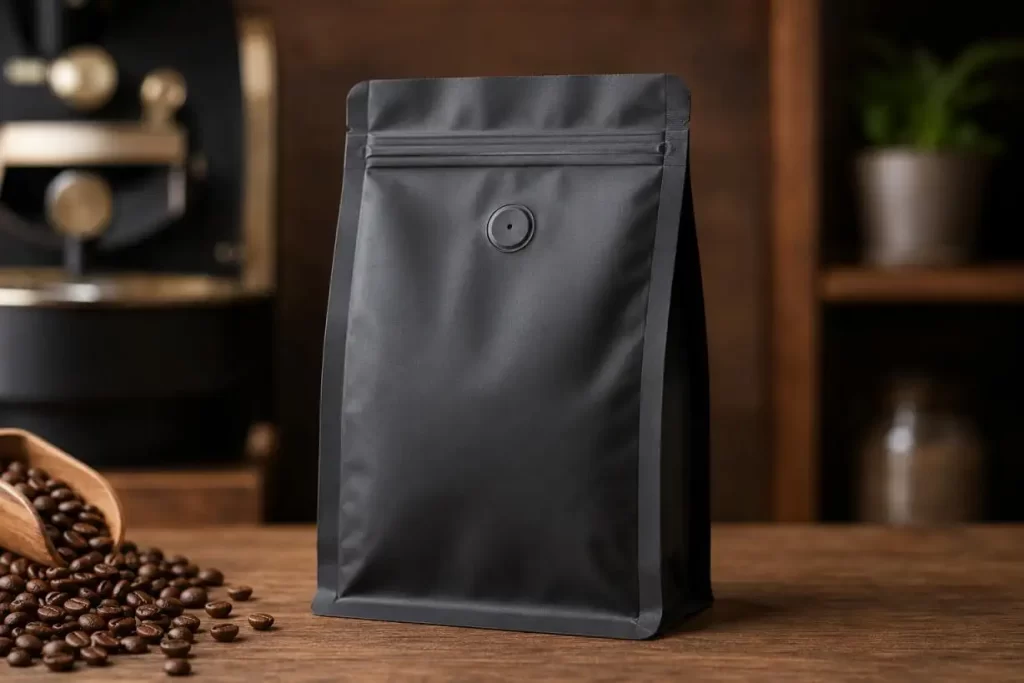
There is no universal valve coordinate for every Flat Bottom Pouch With Degassing Valve.
| Valve Zone | Technical Advantage | Main Risk to Check |
| Higher | Greater separation from normal coffee level | Zipper and top-seal interference |
| Mid-Upper | Balanced product clearance and panel space | Filling-line handling |
| Lower | More flexibility for graphics and upper structures | Greater product-contact risk |
Higher Valve Placement
A higher position generally provides more distance from the coffee fill level. However, moving the valve upward reduces the available area between the valve, zipper and top seal.
Mid-Upper Placement
This is often evaluated when the design needs to balance:
•Sufficient headspace
•Valve clearance
•Branding area
•Automatic filling compatibility
Lower Valve Placement
Lower placement may suit certain layouts, but it needs closer evaluation of coffee contact, especially after transport or when the pouch is laid horizontally.
The correct position is therefore the result of pouch geometry + product behavior + machine requirements, not a universal measurement.
Whole Beans and Ground Coffee Need Different Valve Reviews
Coffee format changes how a Flat Bottom Pouch With Degassing Valve behaves after filling.
| Design Factor | Whole Bean | Ground Coffee |
| Particle Size | Large | Fine |
| Packing Density | Lower and more open | More compact |
| Particle Movement | Individual beans shift easily | Fine particles can migrate |
| Valve Concern | Bean contact and fill height | Dust and fine-particle contamination |
| Key Review | Headspace and transport movement | Valve/filter configuration and cleanliness |
For whole beans, the main concern is usually maintaining enough clearance above the actual product level.
For ground coffee, finer particles may reach functional valve areas more easily. Where required, the valve configuration, filtration feature and installation position should therefore be reviewed together.
Pouch Size Changes the Available Valve Zone
A Flat Bottom Pouch With Degassing Valve should be designed from the intended fill weight backward.
The relationship is straightforward:
Fill Weight → Pouch Dimensions → Fill Height → Headspace → Available Valve Zone
For example, moving from 250g to 1kg changes more than pouch height. It can also change:
•Front-Panel Tension After Filling
•Gusset Expansion
•Product Level
•Headspace Volume
•Zipper-To-Product Distance
•Machine Handling Behavior
Cyan Pak supports custom pouch dimensions, materials, printing, zippers and functional packaging features, allowing valve placement to be adjusted around the actual coffee SKU rather than forcing multiple products into one standard layout.
Automatic Filling Adds Machine Constraints
Valve location must also work with the packaging line.
For premade pouch filling, buyers should check whether the valve can contact:
•Pouch-Opening Suction Cups
•Bag Magazines
•Guide Rails
•Grippers
•Filling Chutes
•Sensors
•Sealing Jaws
A Flat Bottom Pouch With Degassing Valve may perform correctly in manual testing but still create instability at production speed if the valve passes through a machine contact zone.
For automatic filling projects, Cyan Pak can combine custom sizing, material structure, zipper configuration and degassing-valve placement during pouch development. Final samples should still be tested on the customer's actual filling equipment before mass production.
Barrier Performance Still Determines Coffee Protection
A degassing valve manages gas pressure; it does not replace the barrier structure.
A technically specified Flat Bottom Pouch With Degassing Valve should consider at least three measurable properties:
| Parameter | What It Measures | Why It Matters |
| OTR | Oxygen transmission rate | Helps evaluate oxygen barrier |
| WVTR | Water vapor transmission rate | Helps protect against moisture transfer |
| Seal Strength | Mechanical integrity of seals | Helps identify weak seals or leakage |
OTR and WVTR values should always be reviewed together with:
•Material Structure
•Test Method
•Temperature
•Relative Humidity
•Film Thickness
Simply stating "high barrier" provides too little information for meaningful packaging comparison.
Cyan Pak can supply different flexible packaging structures, including high-barrier and more sustainability-focused options. The appropriate construction should be selected according to shelf-life targets, valve compatibility, sealing requirements and the intended recycling route.
What Buyers Should Specify Before Ordering
Before purchasing a Flat Bottom Pouch With Degassing Valve, the RFQ should include four groups of information.
Coffee Product
•Whole Bean Or Ground;
•Target Fill Weight;
•Roast-To-Pack Process;
•Expected Shelf-Life Conditions.
Pouch
•Dimensions;
•Material Structure;
•Barrier Requirement;
•Zipper And Finish;
•Printing Requirements.
Degassing Valve
•Valve Type;
•Required Position;
•Filter Requirement Where Applicable;
•Placement Tolerance.
Filling System
•Manual Or Automatic;
•Premade Pouch Process;
•Machine Handling Points;
•Sealing-Zone Dimensions.
The most reliable decision path is:
Coffee → Fill Level → Headspace → Valve → Material Structure → Filling Machine → Validation
At Cyan Pak, custom dimensions, high-barrier structures, printing, zippers and degassing-valve options can be integrated into the development of a Flat Bottom Pouch With Degassing Valve rather than treated as separate purchasing decisions. For roasters developing a new coffee bag or solving an existing valve-position issue, starting with the actual coffee, target fill weight and filling process provides a stronger basis for a production-ready pouch specification.
FAQs
Q1. What is the ideal position for a Flat Bottom Pouch With Degassing Valve?
It depends on the height of fill, head space, the position of the zipper, the top seal and the filling machine. A valve’s position should be confirmed on a pouch that has been filled.
Q2. Does the valve always need to be on the top of the coffee pouch?
Not necessarily. A higher position can give more clearance to the coffee, but the valve position should ensure that there is enough clearance for the zipper, top seal, and machine.
Q3. Will pouch size affect the position of a degassing valve?
Yes. A 250g, 500g, and 1kg Flat Bottom Pouch With Degassing Valve will have varying fill heights and headspace volumes, so each size must be reviewed individually.
Q4. Will valve position be different for whole bean and ground coffee?
Yes, it can be. Ground coffee can migrate to the valve area, whereas whole bean coffee packing can create a different filling and movement pattern.
Q5. Why could a coffee pouch still swell even with a degassing valve?
Swelling can occur due to CO₂ release, insufficient headspace, valve flow characteristics, product blockage, timing of roast to pack, seal integrity.
Written by
Cyan Pak Coffee
At Cyan Pak Coffee, we provide professional coffee packaging solutions for roasters, cafés, and beverage brands. From design and printing to production and delivery, our team offers a full range of custom packaging services. Our products include coffee bags, boxes, takeaway cups, and other packaging accessories, all customizable in materials, sizes, and print finishes. Focusing on sustainability, innovative design, and low minimum orders, we help brands create unique and efficient packaging experiences.