


Updated 2 months ago
Kraft Paper Flat Bottom Pouch: Structure, Barrier Performance, and Selection Guide
Cyan Pak Coffee
At Cyan Pak Coffee, we provide professional coffee packaging solutions for roasters, cafés, and beverage brands. From design and printing to production and delivery, our team offers a full range of custom packaging services. Our products include coffee bags, boxes, takeaway cups, and other packaging accessories, all customizable in materials, sizes, and print finishes. Focusing on sustainability, innovative design, and low minimum orders, we help brands create unique and efficient packaging experiences.

Kraft Paper Flat Bottom Pouch
A Kraft Paper Flat Bottom Pouch is often selected for coffee, tea, snacks, pet food, powders, and specialty foods because it combines a structured shelf profile with the natural appearance of kraft paper. But from a packaging engineering perspective, appearance is only one part of the specification.
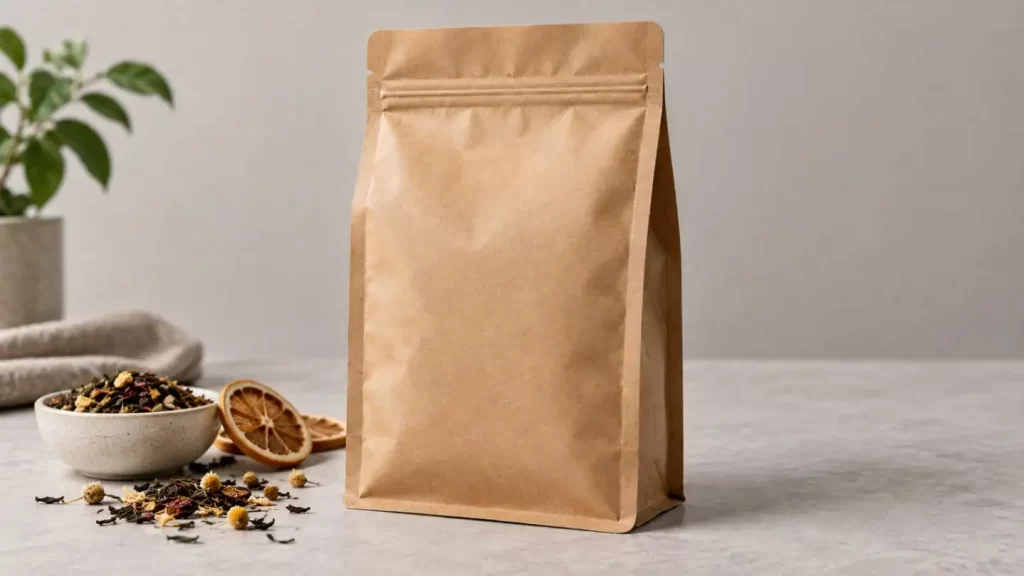
At Cyan Pak, we evaluate a Kraft Paper Flat Bottom Pouch as a complete packaging system: outer paper, barrier laminate, sealant layer, zipper, valve, heat seals, pouch dimensions, filling conditions, and expected shelf life must work together.
That distinction matters because kraft paper alone does not determine product protection.
How Is a Kraft Paper Flat Bottom Pouch Built?
A typical Kraft Paper Flat Bottom Pouch uses a box-like base, two side gussets, and front and back panels. Once filled, the five-panel construction creates a relatively rigid rectangular profile and provides multiple printable surfaces.
The material itself normally performs several different functions:
| Layer / Component | Main Function | What Buyers Should Check |
| Kraft paper exterior | Appearance, stiffness, print surface | Paper weight, finish, print compatibility |
| Barrier layer | Controls oxygen, moisture and light transmission | OTR, WVTR, material type |
| Sealant layer | Creates the inner heat seal | Seal strength, sealing temperature |
| Zipper | Consumer reclosure after opening | Zipper position and usability |
| Degassing valve | Releases gas from fresh coffee | Valve type and placement |
A Kraft Paper Flat Bottom Pouch should therefore be specified by its complete construction rather than simply as a "kraft paper bag."
Barrier Performance: Look Beyond Thickness
For moisture- or oxygen-sensitive products, laminate thickness alone is not a reliable indicator of performance.
OTR: Oxygen Protection
Oxygen Transmission Rate (OTR) measures oxygen passing through a packaging material under defined test conditions. Lower OTR generally indicates stronger oxygen resistance, but meaningful comparisons require the same:
• Test method
• Temperature
• Relative humidity
• Material construction
• Film thickness
Coffee, nuts, tea, and aroma-sensitive foods can be particularly affected by oxygen exposure.
WVTR: Moisture Protection
Water Vapor Transmission Rate (WVTR) indicates how effectively the laminate limits water-vapor transmission.
For a Kraft Paper Flat Bottom Pouch used in humid climates or long distribution chains, WVTR can be as important as OTR.
The practical packaging relationship is:
Barrier structure + OTR/WVTR + seal integrity + storage conditions = Actual product protection
A high-barrier film cannot compensate for a contaminated, incomplete, or weak heat seal.
Common Material Structures
There is no universal "best" Kraft Paper Flat Bottom Pouch material. Structure should follow product sensitivity and shelf-life requirements.
| Structure Direction | Typical Benefit | Key Consideration |
| Kraft Paper / PE-based structure | Heat sealing and basic moisture protection | Suitable only where barrier requirements allow |
| Kraft Paper / PET / PE | Mechanical strength and balanced protection | Conventional multi-material construction |
| Kraft Paper / VMPET / PE | Higher oxygen, moisture and light barrier | Common for sensitive dry products |
| Kraft Paper / AL / PE | Very strong light and barrier protection | More complex material structure |
| Kraft Paper + recyclable-oriented film | Supports sustainability objectives | Must still meet barrier and sealing requirements |
When comparing suppliers, request the exact material construction and relevant barrier data, not just total micron thickness.
Why Flat Bottom Geometry Matters
The flat bottom is more than a visual feature.
Compared with many conventional pouches, a Kraft Paper Flat Bottom Pouch can provide:
• A broad, stable base for upright display
• Front, back, side, and bottom printable areas
• Better shape retention after filling
• Efficient use of retail shelf space
• More room for product information and branding
However, dimensions should be based on actual product volume rather than fill weight alone.
For example, 250 g of dark-roasted whole-bean coffee may require a different internal volume from 250 g of ground coffee because bulk density differs.
Coffee Requires Additional Packaging Decisions
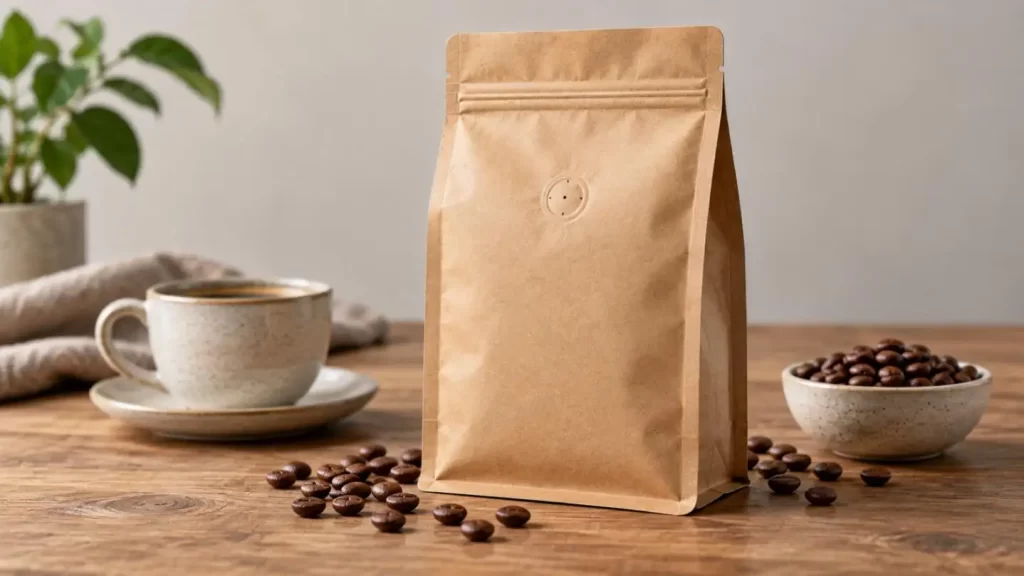
Coffee is one of the most demanding applications for a Kraft Paper Flat Bottom Pouch.
Whole-Bean Coffee
Freshly roasted beans continue releasing CO₂. Depending on roasting and packing schedules, buyers should evaluate:
• Time between roasting and packing
• Expected degassing behavior
• Headspace
• One-way valve requirement
• Valve position
• Oxygen and moisture barrier
• Distribution period
The valve and barrier laminate perform different jobs. The barrier limits environmental transmission; the valve manages gas leaving the package.
Ground Coffee
Grinding increases exposed surface area and changes packaging requirements. Fine particles can also enter the top-seal area during filling.
For ground coffee, we normally recommend evaluating:
Barrier performance → Filling accuracy → Seal cleanliness → Top-seal reliability
Zipper and Heat Seal Are Not the Same Closure
A common specification mistake is treating the zipper as the primary package seal.
Before the consumer opens the pouch:
• Top heat seal: Provides the primary package closure.
• Barrier laminate: Limits oxygen and moisture transmission.
• Degassing valve: Manages gas release where required.
• Zipper: Allows repeated reclosure after opening.
For this reason, zipper position, tear notch, top-seal width, filling opening, and valve location should be engineered together.
Is a Kraft Paper Flat Bottom Pouch Recyclable?
Not necessarily.
The visible kraft paper layer does not determine whether the finished pouch can enter a recycling stream. A laminate combining paper, PET, metallized film, aluminum, and PE can be difficult to separate.
When sustainability is part of the brief, evaluate:
• Complete material composition
• Number of material families
• Required OTR and WVTR
• Product shelf-life target
• Local collection and recycling infrastructure
• Whether a recyclable-oriented structure can provide sufficient protection
Reducing packaging impact should not compromise product protection to the point that food waste increases.
What Should Be Included in a Professional RFQ?
Before ordering a Kraft Paper Flat Bottom Pouch, specify more than size and artwork.
A useful RFQ should include:
• Product: whole bean, ground coffee, powder, snack, etc.
• Net fill weight and approximate bulk density
• Required shelf life
• Target OTR and WVTR where applicable
• Exact laminate structure
• Total thickness
• Zipper and top-seal requirements
• Degassing valve requirement and position
• Manual or automatic filling
• Print method and surface finish
• Destination-market food-contact requirements
• Sustainability or recyclability targets
This information gives the pouch manufacturer a much stronger basis for developing samples and validating the final structure.
Final Thoughts
A Kraft Paper Flat Bottom Pouch should not be selected on kraft appearance, thickness, or price alone. The more reliable approach is:
Product → Shelf Life → Barrier Requirement → Material Structure → Valve/Zipper → Dimensions → Filling Compatibility → Sealing Validation
At Cyan Pak, our systems-based approach allows us to create Kraft Paper Coffee Packaging, including barrier laminates, re-sealable closures, and degassing valves. We can also print your packaging and alter the surface finishes. Furthermore, we can create coffee packaging in a variety of styles and sizes.
To assist you in the development of a Kraft Paper Flat Bottom Pouch for whole-bean or ground coffee, we can use your coffee fill weight and the environment your coffee will be shipped in, to help you select an appropriate package structure to achieve the shelf life of your coffee, and to ship your coffee to your targeted market.
FAQs
Q1. Can Cyan Pak customize Kraft Paper Flat Bottom Pouches?
Yes. Cyan Pak can customize pouch size, material structure, printing, logo, surface finish, zipper, valve, and other functional features according to packaging requirements.
Q2. Does Cyan Pak offer Kraft Paper Flat Bottom Pouches for coffee?
Yes. Cyan Pak provides kraft paper coffee packaging in flat bottom and other pouch formats for whole-bean and ground coffee applications.
Q3. Can Cyan Pak add a one-way degassing valve?
Yes. One-way degassing valves are available to release CO₂ from freshly roasted coffee while helping limit oxygen from entering the pouch.
Q4. What materials can Cyan Pak use for a Kraft Paper Flat Bottom Pouch?
Available structures can include kraft paper combined with materials such as PET, PE, VMPET, and aluminum foil, depending on the required barrier performance.
Q5. Can Cyan Pak provide high-barrier coffee packaging?
Yes. Cyan Pak offers multi-layer barrier structures designed to help protect coffee against oxygen, moisture, light, and aroma loss.
Written by
Cyan Pak Coffee
At Cyan Pak Coffee, we provide professional coffee packaging solutions for roasters, cafés, and beverage brands. From design and printing to production and delivery, our team offers a full range of custom packaging services. Our products include coffee bags, boxes, takeaway cups, and other packaging accessories, all customizable in materials, sizes, and print finishes. Focusing on sustainability, innovative design, and low minimum orders, we help brands create unique and efficient packaging experiences.
Related Articles

Large Capacity Coffee Packaging: Match Bulk Packs to Handling and Customer Needs

Coffee Packaging for Retail Display: Match Your Pack to How Customers Shop

Sustainable Coffee Packaging Bags: Create a Coordinated Packaging Range