

Updated 1 month ago
Beyond Greenwashing: Why Green Packaging Solutions Are Entering the Verifiable Era
Cyan Pak Coffee
At Cyan Pak Coffee, we provide professional coffee packaging solutions for roasters, cafés, and beverage brands. From design and printing to production and delivery, our team offers a full range of custom packaging services. Our products include coffee bags, boxes, takeaway cups, and other packaging accessories, all customizable in materials, sizes, and print finishes. Focusing on sustainability, innovative design, and low minimum orders, we help brands create unique and efficient packaging experiences.

Green Packaging Solutions
Sustainability in packaging is becoming more technical.
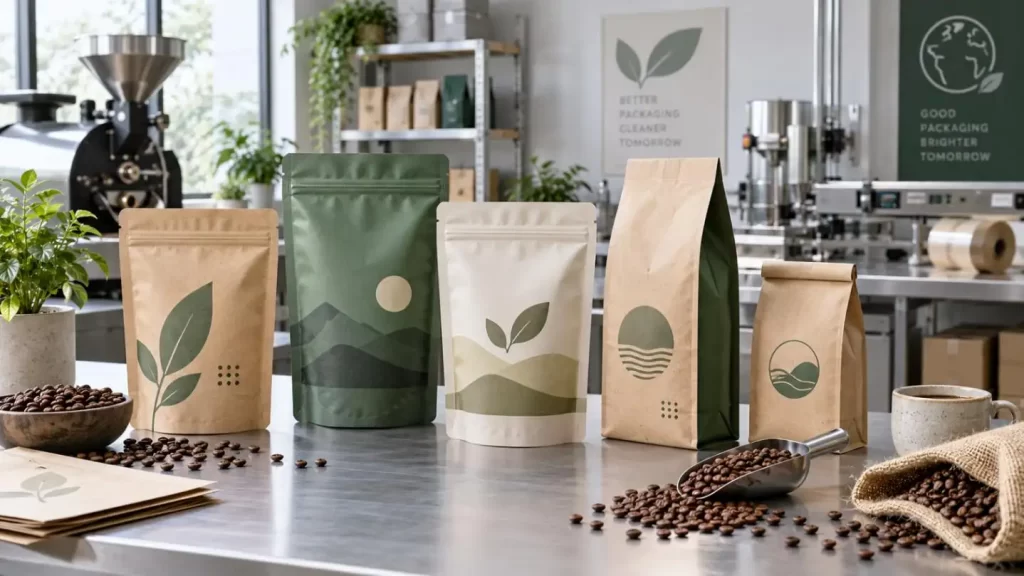
For years, terms such as "eco-friendly," "biodegradable," and "green" were often used as broad marketing descriptions. Today, buyers increasingly expect Green Packaging Solutions to be supported by material data, barrier performance, certification, production compatibility, and a realistic end-of-life pathway.
From our perspective at Cyan Pak, this change is important. Sustainable packaging should not begin with a green label. It should begin with a packaging specification.
What Makes Green Packaging Solutions Verifiable?
A credible Green Packaging Solution should answer five questions:
•What is the packaging made from?
•How well does it protect the product?
•What evidence supports the environmental claim?
•What happens to the packaging after use?
•Can the consumer realistically follow that disposal route?
These questions matter because packaging sustainability is not determined by material choice alone.
A compostable pouch with insufficient barrier performance may shorten product shelf life. A technically recyclable structure may not be collected in every market. A paper-based package can still contain layers that complicate recycling.
For this reason, we evaluate Green Packaging Solutions as complete packaging systems rather than individual materials.
1. Start with Material Structure, Not Appearance
The first main topic is material architecture.
Flexible packaging may consist of:
•Paper-based laminates
•PLA and other bio-based packaging
•Structures from cellulose and other renewable materials
•Film lay-isit aid structures from renewable materials
•Conventional multi-layer laminates
Cyan Pak uses mono-material LDPE to manufacture coffee packaging, and claims that by using mono-material LDPE, they have eliminated the challenges associated with using multiple, and sometimes in- combining materials.
Mono-material structures do, in principle, support recyclability. Still, there are many other challenges to recyclability, including collection, sorting and refining of post-consumer waste.
This distinction is important:
Designed for recycling does not mean recycled everywhere.
That is the type of clarification increasingly expected from professional Green Packaging Solutions.
2. Sustainability Must Include Barrier Performance
For coffee, tea, snacks, and other sensitive products, packaging is also a preservation system.
A sustainable material is not useful if it cannot control:
•Oxygen transmission
•Moisture transmission
•Aroma loss
•Light exposure
•Seal failure
•Puncture during transport
•Carbon dioxide released by roasted coffee
Important engineering parameters include OTR, WVTR, seal strength, film thickness, valve performance, and shelf-life requirements.
At Cyan Pak, packaging specifications can be adjusted according to the application.
| Packaging Format | Typical Cyan Pak Specification |
| Biodegradable coffee pouches | 100–160 μm |
| Stand-up coffee bags | 80–200 μm |
| Compostable roll stock | 50–120 μm |
| Common pouch capacities | 100 g, 250 g, 500 g, 1 kg |
| Printing | Up to 10 colors |
| Roll-stock cores | 3-inch or 6-inch |
These parameters matter because Green Packaging Solutions must work on the packing line and protect the product throughout distribution—not simply meet an environmental positioning objective.
3. Recyclable, Compostable and Biodegradable Are Different Systems
One of the most common sources of confusion is treating these terms as interchangeable.
They are not.
| Packaging Route | Key Technical Question | End-of-Life Dependency |
| Recyclable | Can the material enter an existing recycling stream? | Collection and reprocessing infrastructure |
| Industrial compostable | Can it break down under controlled composting conditions? | Industrial composting facility |
| Home compostable | Can it break down under lower-temperature home conditions? | Correct home-composting environment |
| Biodegradable | Under what conditions does degradation occur? | Material, environment, time and temperature |
When evaluating Green Packaging Solutions, the end-of-life claim should always be linked to real disposal conditions.
"Biodegradable" without defined conditions provides limited technical information.
"Recyclable" without considering local infrastructure can also be misleading.
4. Certification Should Verify a Specific Claim
Certification is useful when buyers understand exactly what has been tested.
A professional packaging review should ask:
•Was the raw material certified?
•Was the film structure tested?
•Does certification apply to the finished pouch?
•Is the claim related to compostability, material sourcing, food contact or another property?
•Which test conditions and standards were used?
For us, certification should support a technical statement—not replace one.
That difference is central to verifiable Green Packaging Solutions.
5. Manufacturing Compatibility Is Part of Sustainability
Packaging also needs to perform efficiently during conversion and filling.
For automatic packing lines, factors such as film tension, sealing behaviour, roll dimensions and machine compatibility can influence waste levels and production efficiency.
Cyan Pak's compostable roll stock, for example, is available in PLA, PBAT, kraft-paper and compostable bio-film structures, with thicknesses from 50 to 120 μm and configurations suitable for VFFS and HFFS equipment.
For printed packaging, we also support both rotogravure and digital production. Digital printing with the HP Indigo 25K allows brands to test smaller runs, multiple SKUs or new designs without immediately moving to large-volume production.
Our minimum order quantity can start from 1,000 pieces for selected plain, digitally printed and rotogravure packaging.
This is another practical aspect of Green Packaging Solutions: reducing unnecessary material and obsolete inventory can be just as relevant as changing the substrate.
6. Consumer Disposal Instructions Complete the System
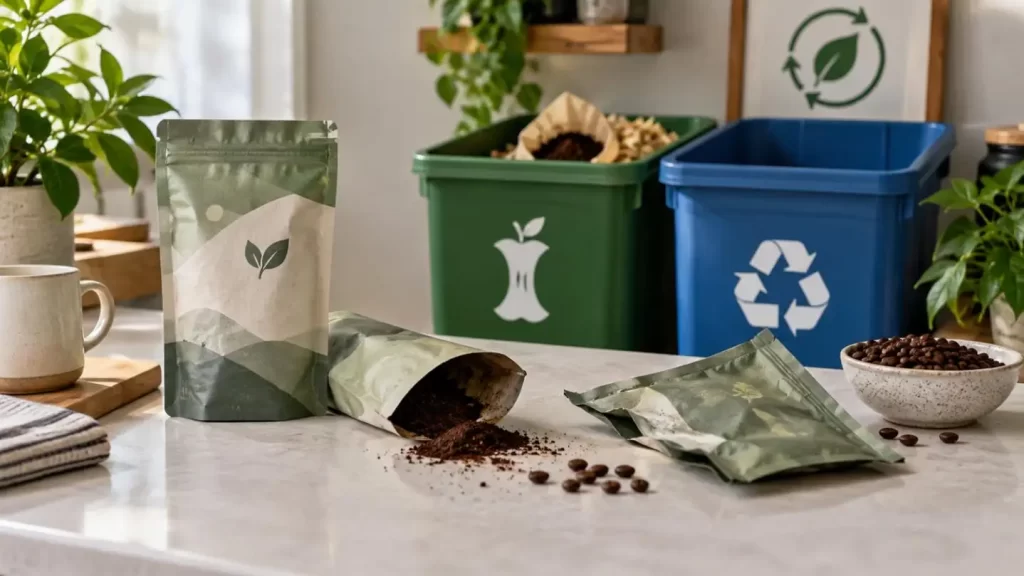
Even technically well-designed packaging can fail at the final stage if the user does not know what to do with it.
Useful disposal communication may include:
•Material identification
•Recycling instructions
•Home vs. industrial composting guidance
•Local disposal information
•QR-linked recycling or material information
A strong Green Packaging Solution should therefore communicate two things clearly:
What is this packaging?
and
What should happen to it after use?
A Practical Green Packaging Checklist
Before selecting sustainable packaging, we recommend checking:
- Material composition — mono-material or multilayer?
- Barrier requirement — what OTR and WVTR performance is needed?
- Package thickness — is the structure heavier than necessary?
- Filling compatibility — pouch filling, VFFS or HFFS?
- Environmental evidence — what supports the claim?
- End-of-life route — recycling, industrial composting or another pathway?
- Local infrastructure — does that pathway actually exist in the target market?
- Consumer communication — are disposal instructions clear?
From Green Claims to Better Packaging Decisions
The next generation of Green Packaging Solutions will be defined less by environmental language and more by measurable packaging performance, transparent material structures and realistic end-of-life planning.
At Cyan Pak, we approach sustainable packaging from both a manufacturing and design perspective. With more than 10 years of packaging manufacturing experience, a production facility of over 5,000 m², ISO 9001 quality management, digital and rotogravure printing capabilities, and recyclable, biodegradable and compostable packaging options, we help brands compare materials against their actual product and production requirements.
The most useful question is no longer:
"Which package looks the most sustainable?"
It is:
"Which packaging structure provides the required protection while creating the most appropriate end-of-life pathway for this market?"
If you are evaluating Green Packaging Solutions for coffee or other flexible-packaging applications, you can explore Cyan Pak's packaging materials, formats and customization capabilities at HERE.
FAQs
Q1. What Green Packaging Solutions does Cyan Pak offer?
Cyan Pak offers recyclable coffee bags, biodegradable packaging, compostable film rolls, and customizable flexible packaging for coffee and other food applications.
Q2. Does Cyan Pak offer recyclable coffee packaging?
Yes. Cyan Pak offers recyclable coffee bags using mono-material LDPE structures designed to combine recyclability with oxygen and moisture barrier protection.
Q3. Are Cyan Pak's compostable films suitable for automatic packaging machines?
Yes. Cyan Pak's compostable roll stock is designed for both VFFS and HFFS packaging systems.
Q4. What materials are available for Cyan Pak compostable film rolls?
Available material options include PLA, PBAT, kraft paper, and compostable bio-film structures.
Q5. What thickness is available for Cyan Pak compostable roll stock?
The compostable film roll can be customized from 50 to 120 microns, depending on the packaging and machine requirements.
Written by
Cyan Pak Coffee
At Cyan Pak Coffee, we provide professional coffee packaging solutions for roasters, cafés, and beverage brands. From design and printing to production and delivery, our team offers a full range of custom packaging services. Our products include coffee bags, boxes, takeaway cups, and other packaging accessories, all customizable in materials, sizes, and print finishes. Focusing on sustainability, innovative design, and low minimum orders, we help brands create unique and efficient packaging experiences.
Related Articles

Large Capacity Coffee Packaging: Match Bulk Packs to Handling and Customer Needs

Coffee Packaging for Retail Display: Match Your Pack to How Customers Shop

Sustainable Coffee Packaging Bags: Create a Coordinated Packaging Range