


Updated 2 months ago
How to Improve Tensile Strength and Puncture Resistance of Biodegradable Packaging Bags

Cyan Pak Coffee
At Cyan Pak Coffee, we provide professional coffee packaging solutions for roasters, cafés, and beverage brands. From design and printing to production and delivery, our team offers a full range of custom packaging services. Our products include coffee bags, boxes, takeaway cups, and other packaging accessories, all customizable in materials, sizes, and print finishes. Focusing on sustainability, innovative design, and low minimum orders, we help brands create unique and efficient packaging experiences.

Biodegradable Packaging Bags
For Biodegradable Packaging Bags, mechanical performance cannot be reduced to one tensile-strength number. A film may test well in tension yet still puncture around a product corner, tear from a notch, or fail beside the heat seal.
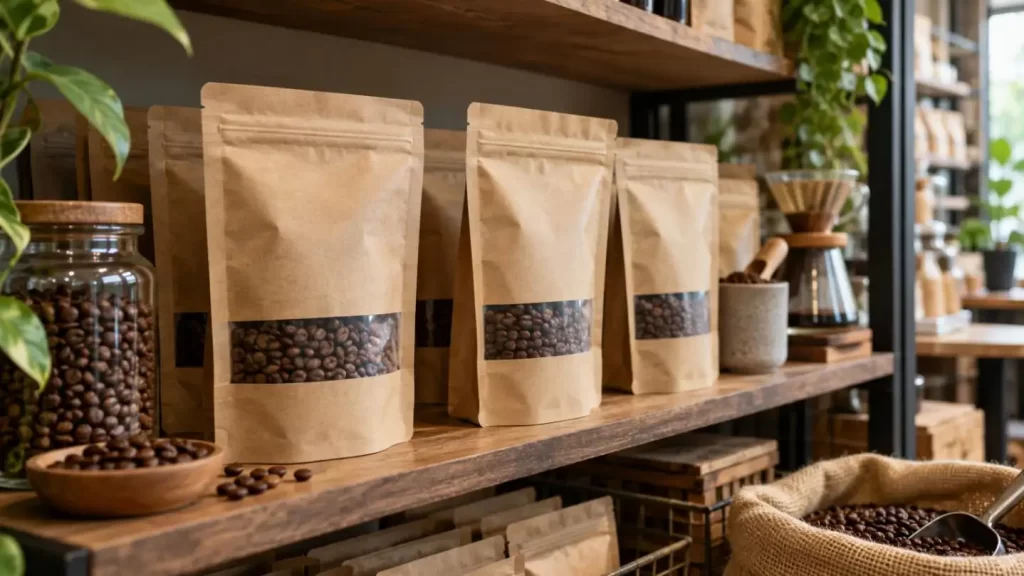
At Cyan Pak, we view durable biodegradable packaging as a system: material formulation, film thickness, orientation, pouch geometry, sealing conditions, product shape, and end-use handling all influence final bag performance.
The right starting point is therefore not "How can we make the film stronger?" but "How is the package actually failing?"
Start with the Failure Mode, Not the Material
Before changing the structure of Biodegradable Packaging Bags, identify where failure begins.
Some typical problems are:
•Rupture: Tensile testing is used to assess the maximum thickness and elongation of the sample as well as its tensile strength.
•Sharp edge puncture: The toughness of the film is evaluated by the work of puncture or the load to puncture.
•Tear propagation: The film is tested for resistance to tearing in the machine and the cross direction.
•Seal failure: The strength of a film seals is evaluated by a variety of methods, including the load to failure.
•Other defects: These are often associated with variability in film thickness.
It is important to understand the differences in failure modes between puncture, tear and tensile tests.
The tensile test of thin film is covered in Standard Practice for Test Methods of Plastic Films and Sheets ASTM D882-26. Standard test methods cover other mechanical tests of thin films as well. For example, test methods for film gauges are covered in Standard Test Methods for Flexible Barrier Film Gauges (ASTM F1306-21(2025)).
Read Tensile Strength, Elongation and Modulus Together
A common specification mistake is selecting Biodegradable Packaging Bags based only on tensile strength.
Three parameters should be interpreted together:
| Parameter | What It Indicates | Why It Matters |
| Tensile strength | Maximum tensile stress | Load-carrying capability |
| Elongation at break | Deformation before rupture | Flexibility and ability to redistribute stress |
| Tensile modulus | Film stiffness | Shape stability and machinability |
| Puncture energy | Energy absorbed before penetration | Resistance to concentrated damage |
A high-strength film with limited elongation can behave differently from a more flexible film capable of absorbing deformation before failure.
ASTM D882 also recognizes tensile energy to break as a measure related to the total energy absorbed before rupture, illustrating why "strongest film" and "toughest film" are not necessarily the same engineering target.
PLA, PBAT and Other Biodegradable Systems Require Trade-Offs
The performance of Biodegradable Packaging Bags starts with polymer selection.
In practical flexible packaging development:
•PLA-rich structures can contribute stiffness but may require modification where high toughness is needed.
•PBAT-containing blends are commonly considered where flexibility and elongation are important.
•PHA-based systems offer another biodegradable polymer route but must still be evaluated for processing, barrier and mechanical requirements.
•Starch-containing compounds can change cost, renewable content, rheology and mechanical behavior.
The objective is not simply to maximize one polymer. The more useful target is an appropriate stiffness–toughness–processability balance.
Four Ways to Improve Bag Durability
| Engineering Route | Potential Benefit | Main Trade-Off |
| Increase film thickness | More material available to carry load | Higher material consumption |
| Adjust polymer blend | Changes stiffness and toughness | May change sealing and processing |
| Improve phase compatibility | Better stress transfer between polymer phases | Requires formulation control |
| Optimize extrusion/orientation | Improves consistency without simply adding material | Depends on process stability |
For Biodegradable Packaging Bags, increasing thickness is therefore only one option—not automatically the most efficient one.
Film Thickness Is Important, but Uniformity Is More Important Than It Looks
Two bags with the same nominal micron specification may not perform identically.
During film manufacture, local gauge variation can create weak zones. Under concentrated stress, failure often begins at the thinnest or most defective area rather than at the "average" thickness.
Similarly, factors such as machine direction (MD) and transverse direction (TD) also need to be studied independently. Machine direction tensile properties can differ from transverse direction tensile properties due to differences in film orientation produced during processing.
ISO 527-3:2018, which remains current after review in 2024, specifically covers tensile testing conditions for plastic films and sheets below 1 mm.
For serious supplier comparison, we recommend asking for:
•Film thickness and tolerance;
•MD and TD tensile strength;
•MD and TD elongation;
•Test method and conditioning conditions;
•Finished-pouch data rather than resin data alone.
Match Puncture Performance to the Product
The required strength of Biodegradable Packaging Bags depends heavily on what goes inside them.
A pouch containing ground coffee experiences a different mechanical environment from a package containing angular hardware or frozen products.
ASTM F1306 notes that penetration performance can vary with factors including film thickness, modulus, penetration rate, temperature and probe geometry.
That means puncture qualification should consider the real application:
Product geometry → Contact point → Expected handling → Film deformation → Package failure risk
For products with hard or irregular edges, puncture energy can be more informative than simply specifying a higher tensile-strength value.
Do Not Ignore the Heat Seal
A mechanically strong biodegradable film can still produce a weak package.
For Biodegradable Packaging Bags, heat sealing is a process window involving:
•Sealing temperature;
•Dwell time;
•Pressure;
•Seal width;
•Contamination at the seal;
•Film thickness and heat-seal layer behavior.
If failure consistently occurs through the seal rather than through the film body, reformulating the entire film may solve the wrong problem.
Packaging-line factors also matter. Excess web tension, worn sealing jaws, damaged cutting blades and sharp contact surfaces can introduce stress or microscopic defects before the package even leaves the machine.
Validate Performance and Compostability Separately
Mechanical improvement and environmental claims are two different qualification tasks.
A useful validation plan for Biodegradable Packaging Bags may include:
•ASTM D882 / ISO 527-3: tensile properties;
•ASTM F1306: slow-rate puncture resistance;
•Separate tear or impact testing where relevant;
•Seal-strength testing on the finished pouch;
•Actual filling, sealing and distribution trials.
Compostability should then be checked against the intended claim and market. ASTM D6400-26 covers plastics and plastic-containing products intended for aerobic municipal or industrial composting facilities; it should not be treated as a general claim that a package will rapidly disappear in any environment.
Additives, printing, adhesives, closures and the final package structure should therefore be considered together with the base resin.
A Better Specification for Biodegradable Packaging Bags
Before approving a supplier, buyers should move through a clear sequence:
Identify failure mode → Define target properties → Compare structures → Validate film → Test the finished pouch → Run it on the packaging line → Verify environmental claims → Approve the specification.
This approach avoids paying for unnecessary thickness while reducing the risk of selecting a "high-strength" material that performs poorly in the actual package.
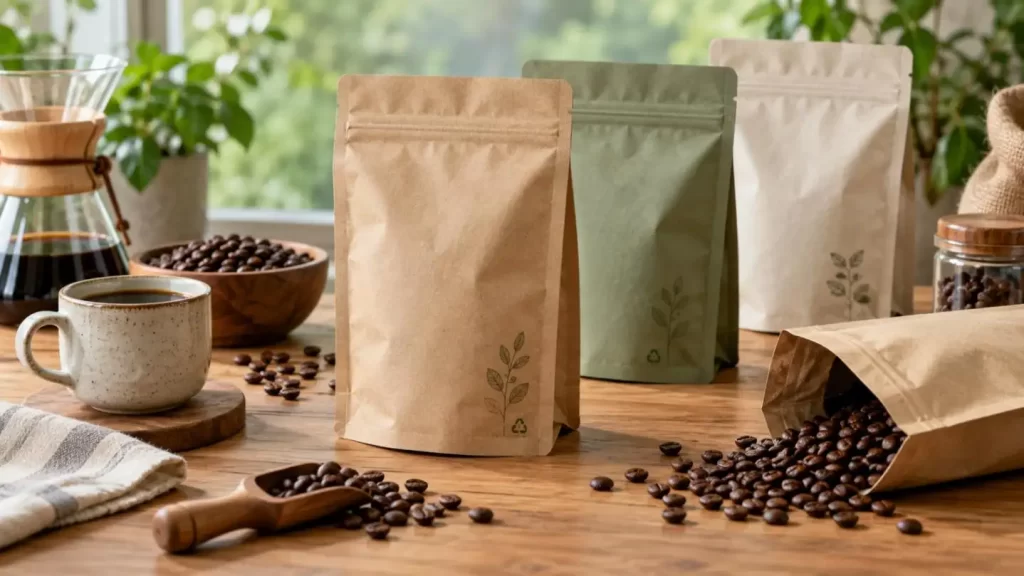
For coffee applications, Cyan Pak currently offers biodegradable coffee bags using multilayer structures designed around strength, printability and protection from moisture and oxygen, with options including heat sealing, resealable zippers and one-way degassing valves. Its published biodegradable coffee pouch specifications include 100–160 μm thickness options for selected formats.
If you are evaluating Biodegradable Packaging Bags for roasted or ground coffee, reviewing the complete structure—not just the sustainability label—is a useful place to start.
FAQs
Q1. What types of Biodegradable Packaging Bags does Cyan Pak offer?
Cyan Pak offers biodegradable coffee packaging in customizable pouch formats, including options for resealable zippers, heat sealing, degassing valves, and printed branding.
Q2. Are Cyan Pak biodegradable coffee bags suitable for roasted coffee?
Yes. Cyan Pak lists its biodegradable coffee bags for roasted coffee beans and ground coffee applications.
Q3. Can Cyan Pak Biodegradable Packaging Bags include a degassing valve?
Yes. A one-way degassing valve is available to release CO₂ from freshly roasted coffee while helping limit oxygen ingress.
Q4. What thickness options are available for Cyan Pak biodegradable coffee bags?
Cyan Pak currently lists selected biodegradable coffee pouch structures in the 100–160 micron range. Exact requirements should be confirmed for each structure and application.
Q5. Can Cyan Pak customize the size and capacity of Biodegradable Packaging Bags?
Yes. Cyan Pak lists multiple standard capacities and also offers customized bag dimensions and formats according to product requirements.
Written by
Cyan Pak Coffee
At Cyan Pak Coffee, we provide professional coffee packaging solutions for roasters, cafés, and beverage brands. From design and printing to production and delivery, our team offers a full range of custom packaging services. Our products include coffee bags, boxes, takeaway cups, and other packaging accessories, all customizable in materials, sizes, and print finishes. Focusing on sustainability, innovative design, and low minimum orders, we help brands create unique and efficient packaging experiences.
Related Articles

Large Capacity Coffee Packaging: Match Bulk Packs to Handling and Customer Needs

Coffee Packaging for Retail Display: Match Your Pack to How Customers Shop

Sustainable Coffee Packaging Bags: Create a Coordinated Packaging Range