

Updated 2 months ago
Eco Friendly Packaging Wholesale: Sustainable Inks, Adhesives and Coatings Explained
Cyan Pak Coffee
At Cyan Pak Coffee, we provide professional coffee packaging solutions for roasters, cafés, and beverage brands. From design and printing to production and delivery, our team offers a full range of custom packaging services. Our products include coffee bags, boxes, takeaway cups, and other packaging accessories, all customizable in materials, sizes, and print finishes. Focusing on sustainability, innovative design, and low minimum orders, we help brands create unique and efficient packaging experiences.

Eco Friendly Packaging Wholesale
For Eco Friendly Packaging Wholesale, choosing a recyclable film is only the starting point. From a flexible-packaging manufacturer's perspective, recyclability and product protection depend on the complete structure: substrate, barrier layer, ink, lamination adhesive, coating, sealant, zipper, valve and final pouch construction.
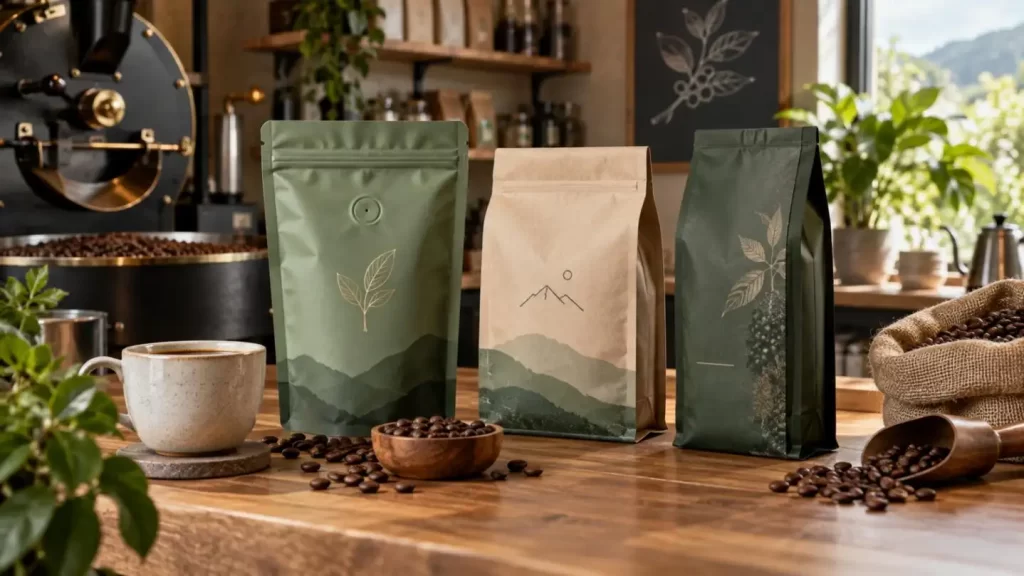
At Cyan Pak, we approach sustainable packaging as an engineering specification rather than a single "eco-friendly" material claim. For coffee packaging in particular, the package still has to control oxygen and moisture, maintain seal integrity and allow freshly roasted coffee to degas without compromising shelf life.
Start With the Complete Packaging Structure
A typical flexible pouch may contain several functional elements:
Printed film → Ink → Adhesive/tie layer → Barrier → Sealant layer → Zipper/valve
Each can affect mechanical recycling. CEFLEX's current Design for a Circular Economy guidance favors mono-PE and mono-PP structures where technically possible and specifically evaluates inks, adhesives, coatings, barriers and closures—not just the main film. Its updated guidance also identifies thresholds such as adhesives/coatings at ≤5% of total pack weight for relevant structures.
For buyers evaluating Eco Friendly Packaging Wholesale, this leads to one practical rule: specify the entire package, not only the substrate.
| Design Variable | Technical Question | Why It Matters |
| Base film | PE, PP or multi-material laminate? | Determines primary recycling stream |
| Ink | What chemistry and print coverage? | Can affect recyclate quality |
| Adhesive | Type and total coat weight? | Excess incompatible material can reduce recyclability |
| Coating | Functional or decorative? | Adds barrier or surface properties, but also complexity |
| Barrier | Required OTR/WVTR? | Controls shelf life |
| Closure | Compatible zipper/valve material? | Accessories should support the intended recycling route |
Inks: Chemistry Is Only Half the Decision
Water-based ink is often discussed in sustainable packaging, but "water-based" should not automatically be interpreted as "fully sustainable." Substrate adhesion, drying energy, color strength, ink coverage and recycling compatibility remain important.
For Eco Friendly Packaging Wholesale, we normally consider:
• Ink system: Water-based, solvent-based or digital, depending on substrate and print process.
• Coverage: Large solid-color areas increase total ink loading.
• White ink: Often requires relatively high laydown on transparent films.
• Color count: Additional colors increase process complexity.
• Surface protection: Some graphics require varnish or protective coating to withstand abrasion.
CEFLEX likewise notes that printing coverage and ink/lacquer color can influence recyclability and recycled-material quality.
Cyan Pak offers water-based ink logo treatments on recyclable LDPE coffee bags, together with interior and exterior printing options. For custom coffee packaging, our published specifications include digital and gravure printing with up to 9 colors, while stand-up coffee pouches can be specified with gravure or flexographic printing at up to 10 colors.
Adhesives: A Small Component With a Large Technical Role
Lamination adhesives bond layers and must maintain bond strength during bag making, filling, sealing, transport and storage. Common systems include solvent-based, solvent-free and water-based adhesives.
A more professional Eco Friendly Packaging Wholesale specification should consider:
1. Adhesive Loading
Recyclability depends partly on how much non-primary material enters the recycling stream. Lower coat weight is beneficial only when required bond performance is maintained.
2. Cure Performance
Some adhesive systems require controlled curing before converting or filling. Insufficient cure can create poor bond strength, delamination or food-contact concerns.
3. Substrate Compatibility
The adhesive must work with printed films, barrier layers and sealants without damaging recyclability or seal performance.
There is therefore no universal "greenest adhesive." It must be evaluated as part of the finished laminate.
Coatings Should Have a Defined Function
Coatings may provide matte appearance, gloss, soft touch, abrasion resistance, grease resistance or barrier enhancement. The technical question is whether each coating adds measurable value.
For Eco Friendly Packaging Wholesale, we separate coatings into two groups:
• Functional coatings: oxygen, moisture, grease, heat or seal performance.
• Decorative coatings: matte, gloss, tactile or visual effects.
Removing a functional barrier simply to reduce material can be counterproductive if product shelf life decreases. Good sustainable design removes unnecessary complexity—not necessary protection.
OTR and WVTR Matter More Than "Eco" Claims
Coffee is sensitive to oxygen, moisture and aroma loss. Two important packaging parameters are:
OTR — Oxygen Transmission Rate: oxygen passing through a material over a defined area and time.
WVTR — Water Vapor Transmission Rate: water vapor passing through the material under defined conditions.
For reference, the traditional PET/Al/PE foil structures at OTR <0.05 cc/m²/day and WVTR <0.01 g/m²/day, while recyclable EVOH/PE structures can reach approximately 0.5–1 cc/m²/day OTR, depending on the construction and test conditions.
This illustrates why Eco Friendly Packaging Wholesale should be specified against a required shelf life rather than simply selecting the lowest-material structure.
A Practical Cyan Pak Coffee-Pouch Specification
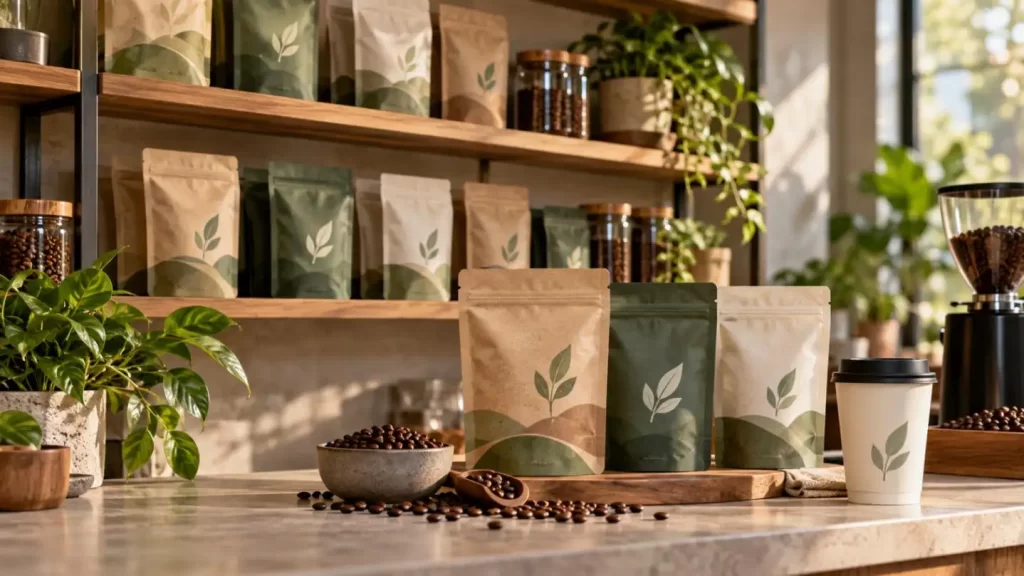
Consider a 250 g roasted-coffee pouch requiring recyclable packaging, resealability and full-color branding.
A practical specification sequence is:
- Define target market and recycling route.
- Select the primary material structure.
- Set required oxygen/moisture barrier.
- Select printing process and ink coverage.
- Review adhesive and coating requirements.
- Match zipper and degassing valve to the structure.
- Validate sealing, filling and shelf-life performance.
Cyan Pak's custom coffee bags are available in 100 g, 250 g, 500 g and 1 kg capacities, with custom sizes, 100–200 μm thickness, zipper/heat-seal/tin-tie closures and optional one-way degassing valves. Matte, gloss, soft-touch and kraft finishes are available.
For recyclable applications, Cyan Pak offers mono-material LDPE coffee bags with oxygen/moisture protection, recyclable degassing valves, resealable zippers and water-based ink logo treatments.
For market testing or multiple SKUs, our HP Indigo 25K digital-printing program supports orders starting from 1,000 pieces, alongside flat-bottom, stand-up and side-gusset formats.
Design the Package as a System
Effective Eco Friendly Packaging Wholesale is not about maximizing environmental claims. It is about balancing recyclability, material efficiency, printing, barrier performance and commercial production.
At Cyan Pak, our role is to help brands translate those requirements into a workable flexible-packaging specification—from recyclable LDPE structures and printing selection to pouch format, valves, finishes and production quantities. Brands developing or reviewing a sustainable coffee-packaging project can explore the available structures and customization options at CyanPak.com and discuss the technical requirements before committing to production.
FAQs
Q1. What eco-friendly packaging does Cyan Pak offer?
Cyan Pak offers recyclable LDPE coffee bags, compostable packaging options, custom coffee pouches, roll film, and other flexible packaging solutions.
Q2. Does Cyan Pak provide recyclable coffee bags?
Yes. Cyan Pak offers recyclable mono-material-oriented LDPE coffee bags designed to combine product protection with improved recycling compatibility.
Q3. What sizes are available for Cyan Pak coffee bags?
Standard capacities include 100 g, 250 g, 500 g, and 1 kg, with custom dimensions available for specific products and filling requirements.
Q4. What thickness options does Cyan Pak offer?
Custom coffee bags are available in approximately 100–200 μm thicknesses, depending on material structure, barrier needs, and pouch format.
Q5. Does Cyan Pak offer low-MOQ custom packaging?
Yes. Cyan Pak's digital printing program supports custom packaging orders starting from approximately 1,000 pieces for suitable projects.
Written by
Cyan Pak Coffee
At Cyan Pak Coffee, we provide professional coffee packaging solutions for roasters, cafés, and beverage brands. From design and printing to production and delivery, our team offers a full range of custom packaging services. Our products include coffee bags, boxes, takeaway cups, and other packaging accessories, all customizable in materials, sizes, and print finishes. Focusing on sustainability, innovative design, and low minimum orders, we help brands create unique and efficient packaging experiences.
Related Articles

Large Capacity Coffee Packaging: Match Bulk Packs to Handling and Customer Needs

Coffee Packaging for Retail Display: Match Your Pack to How Customers Shop

Sustainable Coffee Packaging Bags: Create a Coordinated Packaging Range