

Updated 2 months ago
How Barrier Coatings Improve the Performance of Custom Eco Friendly Packaging Bags
Cyan Pak Coffee
At Cyan Pak Coffee, we provide professional coffee packaging solutions for roasters, cafés, and beverage brands. From design and printing to production and delivery, our team offers a full range of custom packaging services. Our products include coffee bags, boxes, takeaway cups, and other packaging accessories, all customizable in materials, sizes, and print finishes. Focusing on sustainability, innovative design, and low minimum orders, we help brands create unique and efficient packaging experiences.

Custom Eco Friendly Packaging Bags
For brands moving toward recyclable or lower-impact flexible packaging, one technical challenge appears repeatedly: how to simplify the material structure without sacrificing shelf life.
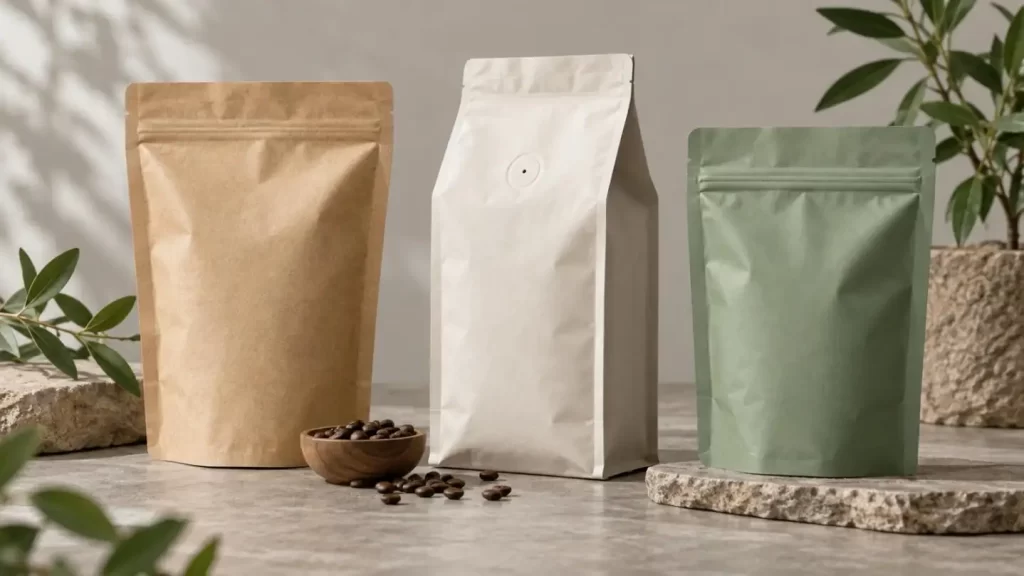
At Cyan Pak, we see this challenge frequently in projects involving Custom Eco Friendly Packaging Bags for coffee, snacks, nuts, powders, pet food, and other oxygen- or moisture-sensitive products.
A recyclable PE or PP structure may provide better end-of-life potential than a conventional multi-material laminate, but the base film alone may not provide the oxygen, moisture, aroma, or light barrier required by the product.
This is where barrier coatings and functional barrier layers become important.
The engineering objective is not simply to produce an "eco-friendly bag." It is to build Custom Eco Friendly Packaging Bags that balance:
• Required shelf life;
• Oxygen and moisture barrier;
• Sealing performance;
• Mechanical durability;
• Filling-line efficiency;
• Recyclability;
• Food-contact compliance.
Why Barrier Performance Matters in Eco-Friendly Packaging
Different products fail for different reasons.
Roasted coffee is sensitive to oxygen and aroma loss. Crispy snacks require moisture protection. Powders can absorb humidity and clump. Nuts and pet foods containing fats may oxidize during storage.
For this reason, barrier specifications should start with the product rather than the packaging material.
Two parameters are particularly important:
| Parameter | What It Measures | Typical Packaging Risk |
| OTR | Oxygen Transmission Rate | Oxidation, aroma loss, rancidity |
| WVTR | Water Vapor Transmission Rate | Moisture absorption, drying, texture loss |
A supplier quoting only "high barrier" is not providing enough technical information.
For Custom Eco Friendly Packaging Bags, OTR and WVTR should always be evaluated together with:
• Test temperature;
• Relative humidity;
• Film structure;
• Film thickness;
• Coating weight;
• Test method.
An OTR value measured under dry laboratory conditions cannot automatically be used to predict performance in a humid distribution environment.
How Barrier Coatings Actually Work
Molecules of oxygen and water vapor can pass through certain types of polymer films. A coating can provide a barrier and reduce the rate of these molecules passing through packaging.
Barrier performance depends on several factors other than the chemistry of the coating.
These factors include:
The Uniformity of the Coating
A uniform barrier coating can be very effective, and a non-uniform barrier coating with defects can be ineffective.
Localized coatings, pinholes and other deficiencies in the barrier coating can result in the coating being essentially ineffective.
Coat Weight and Thickness
Increasing coat weight may improve barrier performance up to a point, but the relationship is not always linear.
Excessive coating can also affect:
• Stiffness;
• Drying or curing;
• Adhesion;
• Recyclability;
• Total material cost.
Temperature and Humidity
Some polymeric oxygen barriers, particularly PVOH- or EVOH-related systems, are sensitive to humidity.
Moisture absorption may plasticize the barrier layer and increase oxygen permeability.
For this reason, Cyan Pak recommends comparing barrier data only when test conditions are clearly stated.
Which Barrier Technology Is Suitable?
There is no single barrier technology that is ideal for every Custom Eco Friendly Packaging Bags project.
| Technology | Main Strength | Main Engineering Consideration |
| Water-based polymer coating | Low coating weight, suitable for simplified structures | Humidity sensitivity must be evaluated |
| PVOH-type coating | Strong oxygen barrier under suitable conditions | Moisture protection may be required |
| EVOH barrier layer | Excellent oxygen barrier | Usually integrated through coextrusion rather than simple surface coating |
| SiOx coating | Transparent, very thin, high barrier potential | Flex cracking and pinholes require validation |
| AlOx coating | Transparent high-barrier option | Deposition quality and handling are critical |
| Metallized film | Strong oxygen, moisture, and light barrier | Opacity and recycling compatibility must be considered |
The correct selection depends on the product and the complete packaging system.
For example, a transparent pouch may favor SiOx or AlOx, while a product requiring strong light protection may still benefit from metallized structures.
Why Mono-Material Packaging Still Requires Engineering
"Mono-material" does not mean that every component of the package is chemically identical.
A recyclable PE or PP structure may still contain limited amounts of:
• Barrier coating;
• Adhesive;
• Ink;
• Tie layer;
• Primer;
• Functional additive.
The important question is whether the complete structure remains compatible with the intended recycling stream.
When we develop Custom Eco Friendly Packaging Bags, we therefore look at the full construction rather than the outer film alone.
A typical design review may include:
Base film → Printing → Barrier layer → Adhesive → Sealant → Zipper or valve
Each layer influences the next.
A technically excellent barrier coating can still fail if it creates poor adhesion, unstable sealing, or excessive cracking during pouch conversion.
Barrier Performance Must Survive the Packaging Line
Laboratory film performance is only the starting point.
During commercial production, Custom Eco Friendly Packaging Bags may undergo:
• Printing;
• Lamination;
• Slitting;
• Gusset formation;
• Zipper insertion;
• Valve application;
• Heat sealing;
• Filling;
• Transportation.
These processes can affect barrier integrity.
For high-barrier structures, Cyan Pak typically considers several operational parameters:
Heat-Sealing Window
The new structure must work within the temperature, pressure, and dwell-time range of the filling line.
Too narrow a sealing window can increase rejects during high-speed production.
COF and Web Handling
The coefficient of friction affects film feeding, stacking, pouch opening, and machine stability.
Barrier or surface coatings can change COF and therefore should be evaluated before full-scale production.
Flex Resistance
Very thin inorganic coatings such as SiOx or AlOx may provide excellent initial barrier values but can lose performance if severe folding creates microcracks.
For demanding applications, barrier testing after mechanical flexing provides more useful information than flat-film data alone.
How Buyers Should Verify Barrier Claims
Before approving Custom Eco Friendly Packaging Bags, buyers should ask for measurable evidence rather than marketing descriptions.
A useful technical review should include:
• Exact material structure;
• Total film thickness;
• OTR test result and conditions;
• WVTR test result and conditions;
• Coating or barrier-layer information;
• Seal-strength data;
• Food-contact documentation;
• Recyclability assessment;
• Production-scale samples.
Finished-pouch testing is also important because film data does not account for zipper areas, valves, seals, folds, or punctures.
Common reference methods include ASTM D3985 for oxygen transmission, ASTM F1249 for water-vapor transmission, and ASTM F88/F88M for seal strength.
Building Better Custom Eco Friendly Packaging Bags
At Cyan Pak, we approach sustainable packaging as a performance-engineering problem rather than simply a material substitution exercise.
The goal is to identify the lowest-complexity structure that can still deliver the required barrier, sealing performance, mechanical strength, production stability, and end-of-life compatibility.
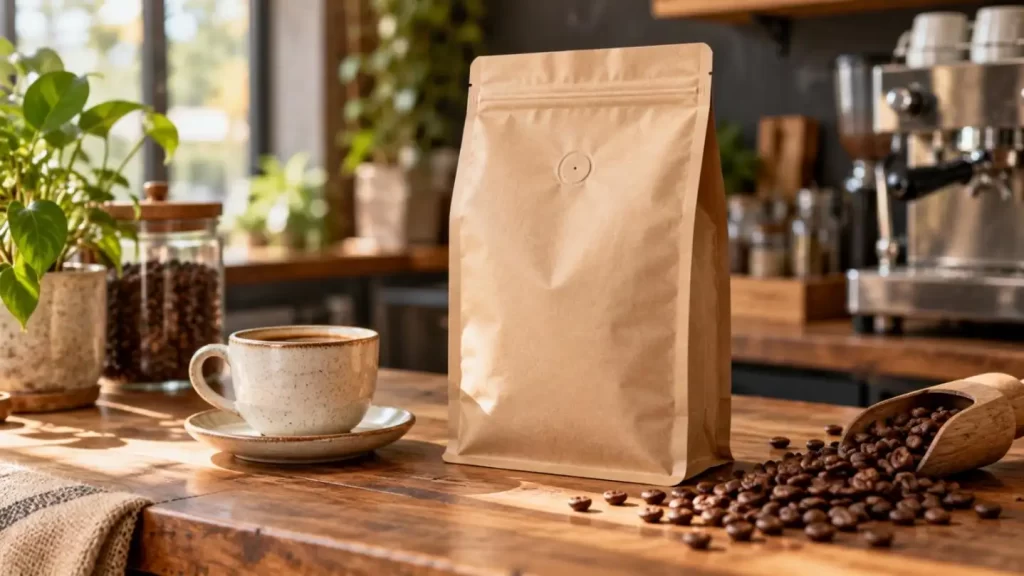
For coffee brands in particular, this may involve recyclable PE structures, alternative sustainable materials, resealable closures, high-barrier layers, and one-way degassing valves working together as one packaging system.
If you are evaluating Custom Eco Friendly Packaging Bags for coffee or other freshness-sensitive products, explore Cyan Pak's eco-friendly coffee packaging solutions to compare material structures and functional options for your next packaging project.
FAQs
Q1. Does Cyan Pak offer Custom Eco Friendly Packaging Bags?
Yes. Cyan Pak offers customizable flexible packaging options, including recyclable bag solutions and Mono PE structures for suitable applications.
Q2. Can Cyan Pak customize the barrier performance of packaging bags?
Yes. Barrier material selection can be matched to the product, required freshness protection, bag structure, and storage conditions. Final OTR and WVTR requirements should be confirmed during specification.
Q3. What bag styles can Cyan Pak manufacture?
Available formats include stand-up pouches, flat-bottom bags, side-gusset bags, quad-seal bags, and other customized flexible packaging formats.
Q4. Can Cyan Pak add one-way degassing valves to coffee bags?
Yes. One-way degassing valves are available for roasted coffee packaging to release CO₂ while helping limit oxygen ingress.
Q5. Are resealable zippers available?
Yes. Cyan Pak can add resealable zippers, tear notches, valves, hang holes, and other functional features depending on the bag design.
Written by
Cyan Pak Coffee
At Cyan Pak Coffee, we provide professional coffee packaging solutions for roasters, cafés, and beverage brands. From design and printing to production and delivery, our team offers a full range of custom packaging services. Our products include coffee bags, boxes, takeaway cups, and other packaging accessories, all customizable in materials, sizes, and print finishes. Focusing on sustainability, innovative design, and low minimum orders, we help brands create unique and efficient packaging experiences.
Related Articles

Large Capacity Coffee Packaging: Match Bulk Packs to Handling and Customer Needs

Coffee Packaging for Retail Display: Match Your Pack to How Customers Shop

Sustainable Coffee Packaging Bags: Create a Coordinated Packaging Range