

Updated 2 months ago
Custom Biodegradable Packaging Supplier: From Material Selection to Mass Production
Cyan Pak Coffee
At Cyan Pak Coffee, we provide professional coffee packaging solutions for roasters, cafés, and beverage brands. From design and printing to production and delivery, our team offers a full range of custom packaging services. Our products include coffee bags, boxes, takeaway cups, and other packaging accessories, all customizable in materials, sizes, and print finishes. Focusing on sustainability, innovative design, and low minimum orders, we help brands create unique and efficient packaging experiences.

Biodegradable Packaging Supplier
For coffee brands, choosing a Biodegradable Packaging Supplier is not simply a matter of replacing conventional plastic with a plant-based film. The package still has to protect roasted coffee from oxygen, moisture, light, aroma loss, and handling damage throughout filling, transport, retail, and consumer use.
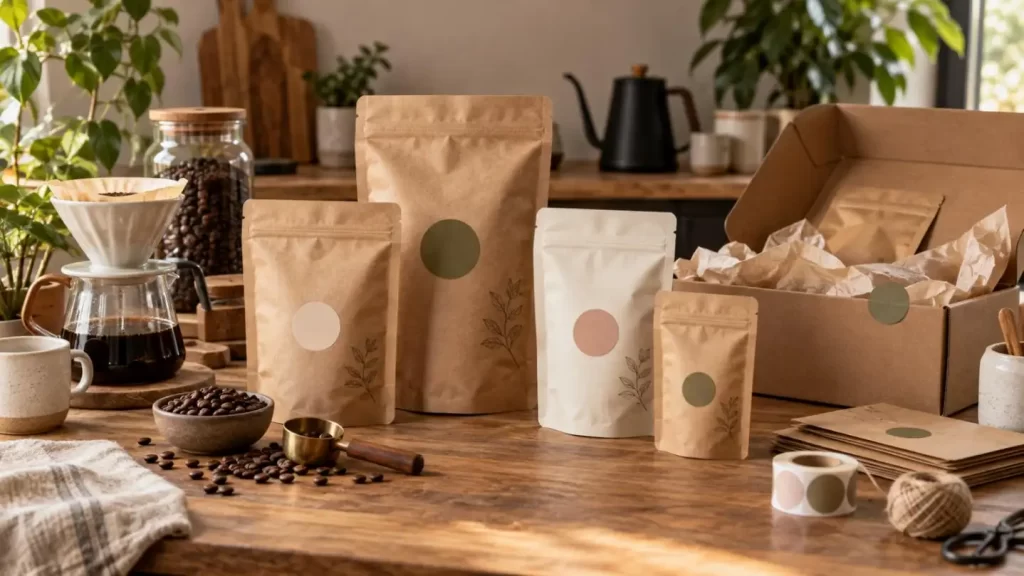
At Cyan Pak, we approach biodegradable packaging as a packaging-engineering project. Material structure, barrier performance, pouch geometry, printing, degassing, sealing, and end-of-life requirements must be considered together before a bag moves into mass production.
What Should a Biodegradable Packaging Supplier Evaluate First?
The starting point should always be the packed product—not the material name.
Before recommending a structure, a Biodegradable Packaging Supplier should understand:
•Whole bean or ground coffee;
•Target fill weight and bulk volume;
•Expected shelf life;
•Oxygen and moisture sensitivity;
•Filling and heat-sealing conditions;
•Storage and shipping environment;
•Required zipper, valve, or tear features;
•Printing quantity and SKU count;
•Intended composting or disposal route.
This matters because biodegradable, compostable, and recyclable describe different end-of-life concepts. A material may be compostable under controlled industrial conditions without being designed to break down efficiently in an uncontrolled natural environment.
Material Selection: Think in Structures, Not Single Films
Coffee packaging is normally a functional structure rather than a single material.
Cyan Pak's biodegradable coffee bag range includes renewable-material options such as Kraft paper, PLA, and rice paper, with optional barrier layers used to improve protection against oxygen and moisture.
A practical material assessment should consider three layers of performance:
| Design Area | What We Evaluate | Why It Matters |
| Outer layer | Printability, stiffness, abrasion resistance | Brand presentation and handling |
| Barrier structure | Oxygen, moisture and light protection | Coffee freshness and aroma retention |
| Sealant layer | Heat-seal compatibility and seal strength | Package integrity after filling |
For technical projects, OTR (oxygen transmission rate) and WVTR (water-vapor transmission rate) are more meaningful than simply describing a film as "high barrier." Actual requirements should be defined according to product shelf life and verified against the selected structure.
Barrier Performance Comes Before Environmental Claims
A sustainable package that allows premature oxidation or moisture ingress can result in product waste. For coffee, that can defeat the environmental objective of changing the packaging in the first place.
A competent Biodegradable Packaging Supplier therefore evaluates:
Oxygen Barrier
Roasted coffee oxidizes after exposure to oxygen, affecting aroma and flavor stability.
Moisture Barrier
Moisture transfer can influence roasted coffee quality and storage stability.
Seal Integrity
Even a good barrier film performs poorly if the top seal, side seals, zipper area, or valve installation creates leakage paths.
Mechanical Strength
The pouch must tolerate filling, carton packing, international shipping, shelf handling, and repeated opening.
Our biodegradable coffee pouch range currently includes 100g, 250g, 500g and 1kg capacities, with listed thickness options of 100–160 microns and heat-seal or zipper-seal configurations.
Coffee Packaging Requires Degassing Engineering
Freshly roasted coffee continues to release CO₂ after roasting. A sealed package therefore needs to manage internal gas without allowing excessive external oxygen into the bag.
A one-way degassing valve is commonly used for this purpose.
Cyan Pak biodegradable pouch configurations can incorporate:
•One-way degassing valves;
•Resealable zippers;
•Tear notches;
•Laser scoring;
•Heat-seal closures;
•Custom printed surfaces.
Valve location also matters. It must be positioned away from critical seals, zipper tracks, important artwork, and areas that may interfere with filling equipment.
This is why an experienced Biodegradable Packaging Supplier should engineer the pouch as a complete system rather than add components after the bag has already been designed.
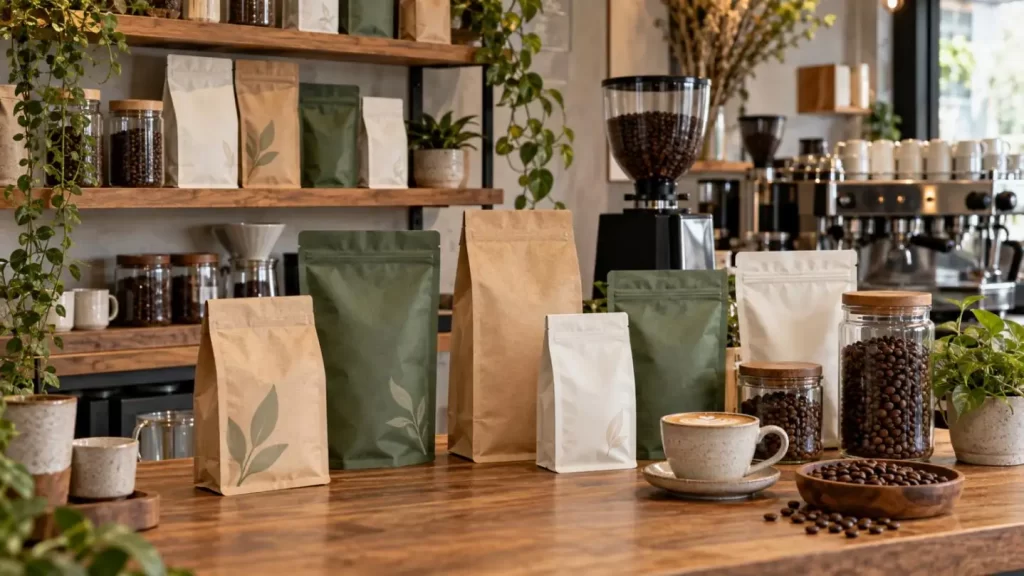
Practical Example: Cyan Pak 250g Coffee Bag
A 250g coffee pouch is a useful example of how these decisions come together.
Cyan Pak lists its 250g Coffee Bag at 110 × 190 × 80 mm, with matte white, matte black, brown Kraft, and white Kraft finishes. The product is packed at 1,000 pieces per paper carton, and the 250g format is available with a compostable PLA material option.
A biodegradable configuration might therefore be specified as:
| Parameter | Example Specification |
| Fill weight | 250g roasted coffee |
| Bag size | 110 × 190 × 80 mm |
| Material option | Compostable PLA |
| Closure | Resealable zipper + heat seal |
| Coffee feature | One-way degassing valve |
| Printing | Custom digital print |
| Validation | Fill, seal, valve and artwork testing |
The final laminate should still be selected according to shelf-life requirements, distribution conditions, and the compostability claim required in the destination market.
Printing Method Should Match Production Volume
As a Biodegradable Packaging Supplier, we also consider how artwork volume affects manufacturing efficiency.
Digital printing is particularly useful for:
•Multiple coffee origins or SKUs;
•Limited editions;
•Seasonal releases;
•Lower-volume market tests;
•Frequent artwork changes.
For stable, higher-volume programs, rotogravure or flexographic printing may offer a more appropriate production route.
Cyan Pak currently combines digital, rotogravure, and flexographic printing capabilities with an in-house design team. Our company reports production facilities in Shanghai and Guangdong, approximately 15,000 m² of factory area and annual production capacity exceeding 5,000 tons.
Why Sampling Is a Production Step, Not a Formality
We recommend testing physical samples before committing a new pouch to mass production.
A sample should confirm:
•Actual filling volume;
•Pouch dimensions and gusset expansion;
•Artwork registration and color appearance;
•Zipper opening performance;
•Degassing-valve position;
•Heat-seal integrity;
•Overall shelf presentation.
For example, 250g of whole beans occupies a different volume from 250g of ground coffee. Bag capacity should therefore be validated using the actual product whenever possible.
From Approved Sample to Mass Production
Once specifications are locked, a typical manufacturing flow is:
Material inspection → Printing → Lamination/structure preparation → Curing where required → Bag making → Zipper and valve integration → Cutting → QC inspection → Packing
Quality control should focus on dimensional tolerance, print registration, sealing consistency, zipper function, valve installation, contamination, and repeat-order color consistency.
These controls are a core responsibility of a professional Biodegradable Packaging Supplier because sustainability does not replace the basic requirements of food-packaging performance.
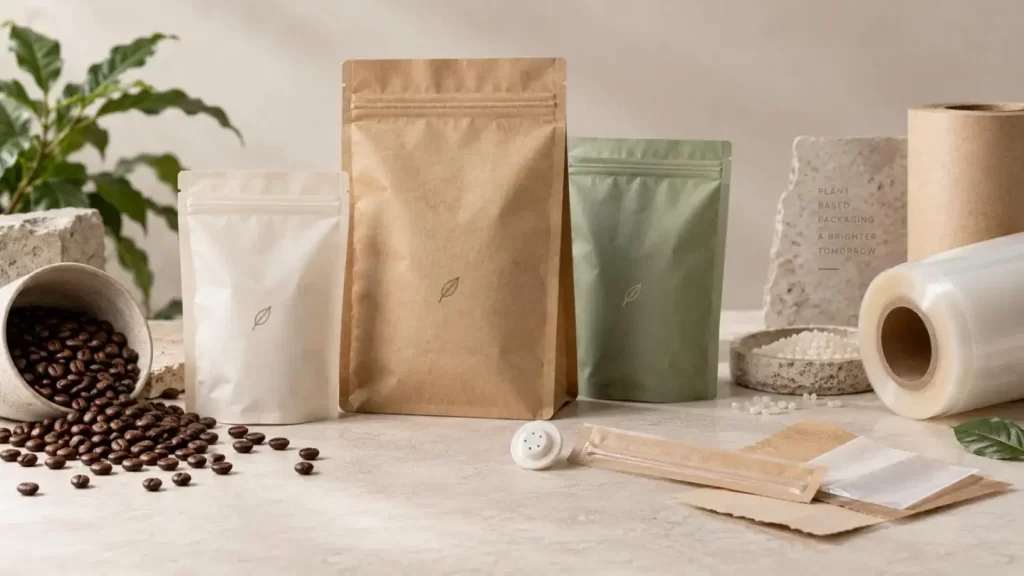
Choosing the Right Biodegradable Packaging Supplier
Before placing an order, buyers should ask for clear answers to four questions:
•What is the exact material and barrier structure?
•What disposal or composting environment is the structure designed for?
•How will the valve, zipper and seals be validated?
•How will samples be transferred into repeatable mass-production specifications?
For us at Cyan Pak, biodegradable coffee packaging means the right balance between sustainability, protection of the product, consistency in manufacturing and, last but not least, the brand.
Biodegradable coffee packaging offers many options in terms of materials, barrier structures, closures and valves. Further, the package can be printed to include graphics and branding. If you are developing, or re-evaluating, a coffee packaging format, contact us to review sample structures and determine how they might meet your requirements.
FAQs
Q1. What biodegradable coffee packaging does Cyan Pak offer?
Cyan Pak offers customizable biodegradable coffee bags using materials such as Kraft paper, PLA, and rice paper, with optional barrier structures.
Q2. What sizes are available for Cyan Pak biodegradable coffee bags?
Available formats include 100g, 250g, 500g, and 1kg biodegradable coffee pouches, depending on the selected structure and application.
Q3. What are the dimensions of Cyan Pak's 250g coffee bag?
Cyan Pak lists its 250g coffee bag at approximately 110 × 190 × 80 mm.
Q4. Can Cyan Pak produce compostable PLA coffee bags?
Yes. Cyan Pak offers a compostable PLA material option for selected coffee packaging formats, including 250g coffee bags.
Q5. Can biodegradable coffee bags include a degassing valve?
Yes. Cyan Pak can integrate one-way degassing valves to allow CO₂ from freshly roasted coffee to escape while helping limit oxygen ingress.
Written by
Cyan Pak Coffee
At Cyan Pak Coffee, we provide professional coffee packaging solutions for roasters, cafés, and beverage brands. From design and printing to production and delivery, our team offers a full range of custom packaging services. Our products include coffee bags, boxes, takeaway cups, and other packaging accessories, all customizable in materials, sizes, and print finishes. Focusing on sustainability, innovative design, and low minimum orders, we help brands create unique and efficient packaging experiences.
Related Articles

Large Capacity Coffee Packaging: Match Bulk Packs to Handling and Customer Needs

Coffee Packaging for Retail Display: Match Your Pack to How Customers Shop

Sustainable Coffee Packaging Bags: Create a Coordinated Packaging Range