

Updated 2 months ago
Not All Recyclable Packaging Is the Same: Differences Behind Recyclable Packaging
Cyan Pak Coffee
At Cyan Pak Coffee, we provide professional coffee packaging solutions for roasters, cafés, and beverage brands. From design and printing to production and delivery, our team offers a full range of custom packaging services. Our products include coffee bags, boxes, takeaway cups, and other packaging accessories, all customizable in materials, sizes, and print finishes. Focusing on sustainability, innovative design, and low minimum orders, we help brands create unique and efficient packaging experiences.

Recyclable Packaging
The term Recyclable Packaging can describe very different technical solutions. Two coffee bags may both be marketed as recyclable, yet differ substantially in polymer composition, oxygen barrier, sealing behaviour, printing system, valve construction and compatibility with the recycling stream.
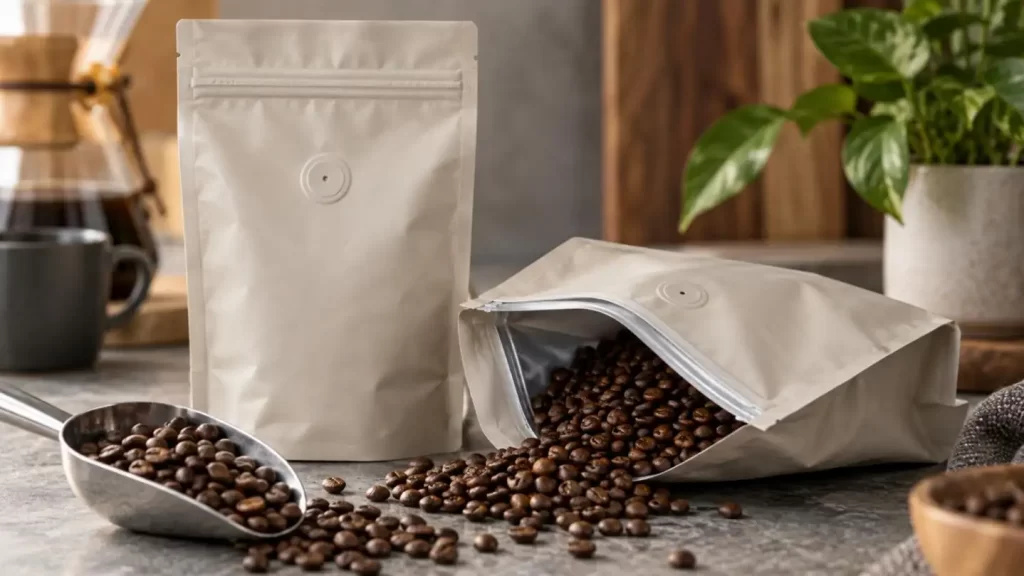
At Cyan Pak, we therefore do not evaluate Recyclable Packaging by the base film alone. For coffee packaging in particular, the complete system matters:
Polymer structure → Barrier → Zipper and valve → Printing → Converting → Filling → Recycling
Understanding these differences helps buyers distinguish a genuinely engineered recyclable pouch from a conventional package that has simply changed its material label.
1. Recyclable Packaging Starts With Polymer Architecture
For flexible packaging, mono-PE and mono-PP structures are increasingly used because they keep most of the package within one polymer family.
CEFLEX recommends favouring mono-PE or mono-PP where technically practical, but it also evaluates barrier layers, coatings, adhesives, inks and closures because each can affect sorting and recyclate quality.
The main material therefore tells only part of the story.
| Structure | Typical Strength | Main Design Risk |
| Mono-PE | Flexibility, toughness, heat sealing | Lower stiffness and heat resistance |
| Mono-PP | Stiffness, dimensional stability | Different sealing behaviour |
| PE + functional barrier | Better oxygen protection | Barrier compatibility must be assessed |
| Conventional multimaterial | Mature barrier performance | More complex material separation |
For coffee, we commonly work with LDPE-based Recyclable Packaging because PE provides a practical combination of flexibility, sealing performance and mechanical durability.
2. "Mono-Material" Does Not Mean "No Barrier Layer"
One of the most common misunderstandings is that Recyclable Packaging must consist of one polymer and nothing else.
Coffee still needs protection from:
• Oxygen, which accelerates oxidation;
• Moisture, which can affect flavour and quality;
• Aroma loss during storage;
• External odours;
• Light, depending on the product and structure.
That means a recyclable pouch may still require EVOH, a functional coating or another carefully controlled barrier technology.
The objective is not to eliminate every functional layer. It is to achieve the required shelf life with the lowest necessary structural complexity.
CEFLEX's current guidance specifically sets design considerations for barriers, coatings, adhesives, inks and tie layers. Its 2025 update also added more evidence-based compatibility thresholds for flexible packaging structures.
For technical purchasing, ask for more than "high barrier." Request the complete structure plus OTR and WVTR data under clearly stated test conditions when barrier performance is critical.
3. Coffee Valves and Zippers Are Part of the Material System
Coffee makes Recyclable Packaging especially demanding because freshly roasted beans continue releasing CO₂ after packing.
A one-way degassing valve must allow CO₂ to escape while limiting oxygen ingress. A resealable zipper must preserve convenience without introducing an incompatible component into the recycling stream.
CEFLEX recommends aligning components such as zippers, closures and valves with the main polymer whenever possible.
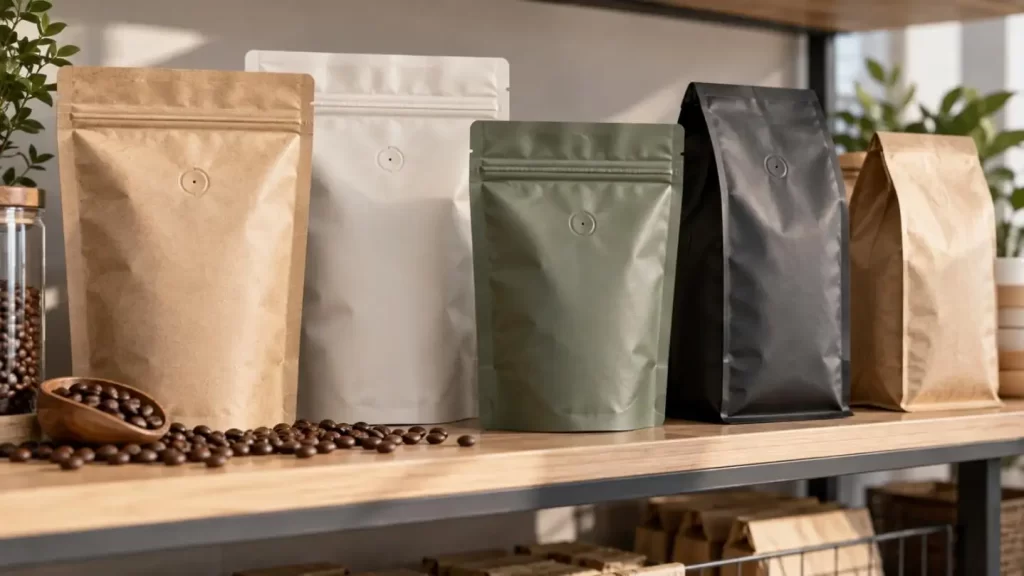
For this reason, Cyan Pak designs recyclable coffee bags as a complete pouch rather than treating accessories as afterthoughts. Our recyclable LDPE range can incorporate recyclable degassing valves, resealable zippers, additional protective layers, transparent windows and custom interior or exterior printing.
Selected Cyan Pak Mono-PE flat-bottom coffee bags also use PE-based zippers and PE valves, keeping these functional components within the PE material family.
4. Printing Can Change Recyclability Too
Printing is often viewed as a branding decision. From a recycling perspective, it is also a material decision.
Ink chemistry, coverage, coatings, varnishes and laminating adhesives can influence:
• NIR identification and sorting;
• Washing and reprocessing;
• Melt filtration;
• Colour contamination;
• Final recyclate quality.
RecyClass updated its PE and PP flexible packaging Design for Recycling guidance in March 2026, including new laboratory findings for printing inks.
At Cyan Pak, this is why artwork and material structure should be considered together. Our recyclable coffee packaging supports custom interior and exterior graphics, including water-based ink and special-effect options.
The practical question is not simply "Can we print this design?" but "Can we achieve the visual result without unnecessarily complicating the Recyclable Packaging structure?"
5. Recyclable Packaging Must Survive the Packing Line
A recyclable structure is not commercially useful if sealing becomes unstable at production speed.
Compared with PET-based laminates, PE-rich Recyclable Packaging can require different settings for:
• Seal temperature;
• Dwell time;
• Jaw pressure;
• Hot tack;
• Web tension;
• Coefficient of friction;
• Zipper and valve sealing.
A material may have excellent barrier data but still fail because of a narrow sealing window or poor pouch integrity.
Cyan Pak's Mono-PE flat-bottom bags are designed for conventional heat-sealing equipment, although PE-specific temperature and dwell-time settings should be established during trials.
For buyers changing from PET/foil laminates, we recommend validating the pouch on the actual filling line rather than qualifying it from laboratory data alone.
6. Specifications Separate One Recyclable Package From Another
Cyan Pak's recyclable flat-bottom range illustrates why Recyclable Packaging should be purchased as a specification rather than a generic material.
| Parameter | Cyan Pak Available Specification |
| Capacity | 250 g / 500 g / 1 kg / custom |
| Thickness | 100–150 μm, customizable |
| Printing | Gravure or digital |
| Print colours | Up to 10 |
| Closure | Zipper / heat seal / optional tin tie |
| Finish | Matte / gloss / kraft texture |
| Format | Flat-bottom / box pouch |
These specifications are listed for selected recyclable flat-bottom coffee bags; material configuration is customizable according to the application.
The thickest film is not automatically the best choice. A 250 g specialty coffee pack and a 1 kg export pouch may require different stiffness, puncture resistance, valve positioning and barrier performance.
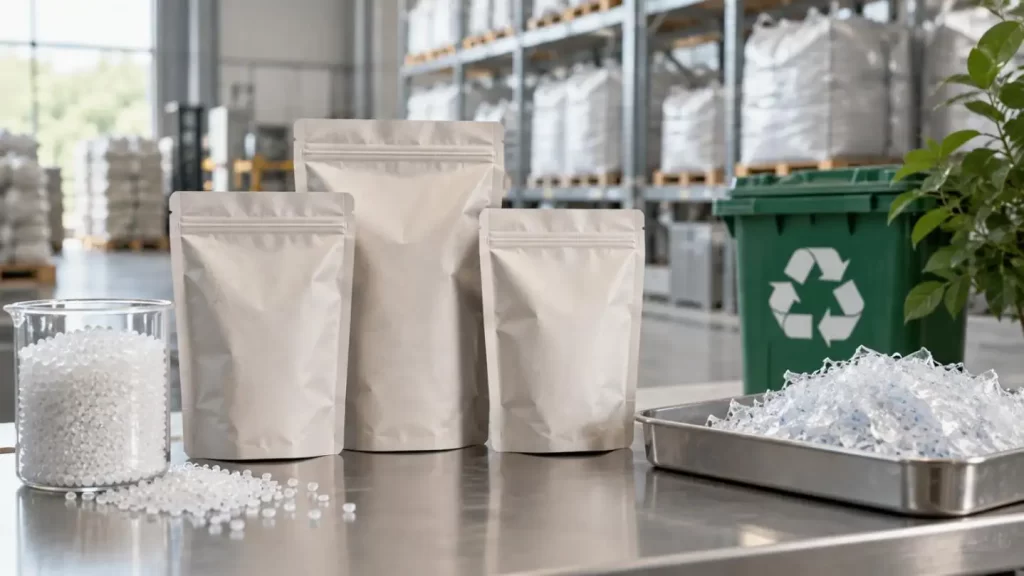
7. Recyclable Does Not Mean Recycled Everywhere
A technically well-designed Recyclable Packaging structure still depends on the destination market.
The real end-of-life pathway includes:
Collection → Sorting → Identification → Recycling → Usable recyclate
A package may be technically compatible with PE recycling but still face limited collection infrastructure in a particular region. CEFLEX therefore evaluates not only material composition but also sortability, including NIR and other sorting considerations.
This is why recyclability claims should always be considered in relation to the intended recycling system.
Closing Words
Good Recyclable Packaging is not defined by a single "recyclable" claim. It is the result of balancing coffee protection, material compatibility, converting performance, filling reliability and end-of-life design.
At Cyan Pak, we use this system-level approach when developing recyclable coffee bags, combining LDPE-based structures with customizable barriers, PE-compatible functional components, printing and pouch formats.
For coffee brands reviewing a move from conventional laminates to Recyclable Packaging, the next useful step is to compare the complete pouch specification against your coffee, target shelf life, filling process and destination market.
FAQs
Q1. What material does Cyan Pak use for recyclable coffee bags?
Cyan Pak offers LDPE mono-material Recyclable Packaging designed to combine flexibility, durability, barrier protection and easier recycling compared with traditional multilayer structures.
Q2. Are Cyan Pak recyclable coffee bags mono-material?
Yes. Cyan Pak's recyclable coffee bag range includes mono-material LDPE structures intended to simplify the recycling process.
Q3. Can Cyan Pak Recyclable Packaging protect coffee from oxygen and moisture?
Yes. Cyan Pak states that its LDPE recyclable structures provide barrier protection against oxygen and moisture, with additional protective layers available when required.
Q4. Can recyclable coffee bags include a degassing valve?
Yes. Cyan Pak offers recyclable degassing valves that allow CO₂ released by roasted coffee to escape while helping maintain freshness.
Q5. Are resealable zippers available?
Yes. Resealable zipper options are available to help consumers close the coffee bag after opening and maintain product freshness.
Written by
Cyan Pak Coffee
At Cyan Pak Coffee, we provide professional coffee packaging solutions for roasters, cafés, and beverage brands. From design and printing to production and delivery, our team offers a full range of custom packaging services. Our products include coffee bags, boxes, takeaway cups, and other packaging accessories, all customizable in materials, sizes, and print finishes. Focusing on sustainability, innovative design, and low minimum orders, we help brands create unique and efficient packaging experiences.
Related Articles

Large Capacity Coffee Packaging: Match Bulk Packs to Handling and Customer Needs

Coffee Packaging for Retail Display: Match Your Pack to How Customers Shop

Sustainable Coffee Packaging Bags: Create a Coordinated Packaging Range