


Updated 3 weeks ago
Coffee Pouch for Automatic Filling Whole Beans vs. Ground Coffee: What Changes?

Cyan Pak Coffee
At Cyan Pak Coffee, we provide professional coffee packaging solutions for roasters, cafés, and beverage brands. From design and printing to production and delivery, our team offers a full range of custom packaging services. Our products include coffee bags, boxes, takeaway cups, and other packaging accessories, all customizable in materials, sizes, and print finishes. Focusing on sustainability, innovative design, and low minimum orders, we help brands create unique and efficient packaging experiences.
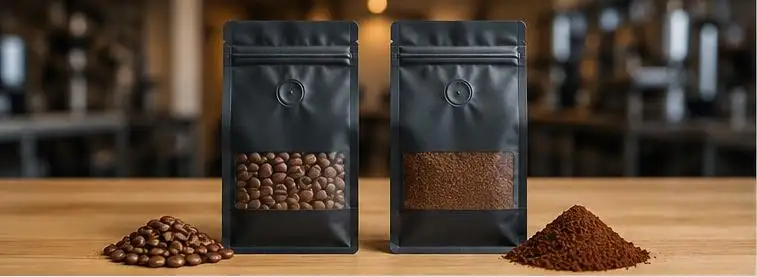
Coffee Pouch for Automatic Filling
A Coffee Pouch for Automatic Filling should do more than hold the correct net weight. It has to feed consistently, open cleanly, accept the product without contaminating the seal area, close within a stable heat-seal window, and maintain the required barrier after filling.
That becomes especially important when comparing whole beans with ground coffee. Although both may be packed at 250 g, 500 g, or 1 kg, their bulk density, particle behavior, dust generation, CO₂ release, dosing method, and sealing risks are different. Those differences should influence both pouch specification and filling-line setup.
Why Whole Beans and Ground Coffee Need Different Filling Strategies
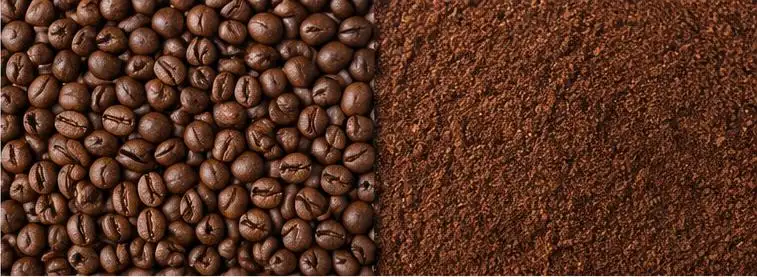
Whole beans behave as relatively large, free-moving particles. Ground coffee is a particulate powder whose behavior changes with grind size, roast profile, moisture condition, and particle-size distribution.
The result is a different automatic-filling challenge.
| Filling Factor | Whole Beans | Ground Coffee |
| Product behavior | Discrete particles | Fine particulate material |
| Typical dosing logic | Weigh-based filling | Auger or powder-oriented dosing |
| Dust generation | Relatively low | Higher |
| Seal contamination risk | Moderate | Higher |
| Product settling | Bean-dependent | Grind-dependent |
| Degassing behavior | Important after roasting | Changes after grinding |
| Main pouch concern | Volume + gas management | Dust + dosing + seal integrity |
Grinding increases exposed surface area and changes how gases are released from roasted coffee. Therefore, a Coffee Pouch for Automatic Filling should not use valve configuration or headspace based only on pack weight.
Start With Bulk Density, Not Nominal Bag Weight
One of the most common specification errors is selecting pouch dimensions from weight alone.
A more useful engineering sequence is:
Net Weight → Bulk Density → Actual Fill Volume → Required Headspace → Pouch Dimensions
Whole beans and ground coffee at the same weight can occupy different volumes. The difference can become even greater between light and dark roasts or between coarse and fine grounds.
There are several considerations when finalizing pouch dimensions which include width, height, and depth of gussets.
•Product Settling: Pouches must eventually draw together in the sealing area and allow for settling of the product.
•Headspace: Space is required for freshly roasted coffee releases CO₂ and is very important in pouches.
•Zipper Clearance: Product can accumulate and obstruct the zipper track and should be avoided.
•Valve Position: The valve should not fall within the gripper sealing area.
•Clean Seal Margin: Ground coffee leaves a powdery residue requiring additional distance between the fill level and the final seal.
Cyan Pak provides coffee packaging formats including flat-bottom bags, stand-up pouches, side-gusset bags, and quad-seal bags, allowing pouch geometry to be adjusted around coffee volume, retail presentation, and automatic filling requirements rather than using one generic bag format.
Whole Beans: Control Volume, Weighing and Degassing
Whole beans are often filled using weighing-based systems because individual beans can be placed in weigh buckets prior to discharge.
Potential buyers of the Coffee Pouch for Automatic Filling should consider the following:
•Clearance height: Rapid discharge will not be possible with insufficient clearance above the pouch mouth.
•Impact distance: If impact distance is increased, the beans will hit the pouch and will likely start to bounce.
•Predictable opening: The bag should not be filled before the opening device operates.
•Fill height: It may cause issues for downstream operations if the pouch is filled past the valve, zipper or seal.
•Degassing: Freshly roasted coffee beans continue to release CO₂ post-packaging.
For coffee packaging where the roast-to-pack interval and the characteristics of the coffee require management of gas, one-directional degassing valves can be useful. However, the valve is one component of the package, so the barrier performance and seal integrity must be maintained.
Ground Coffee: Dust Control Becomes a Sealing Issue
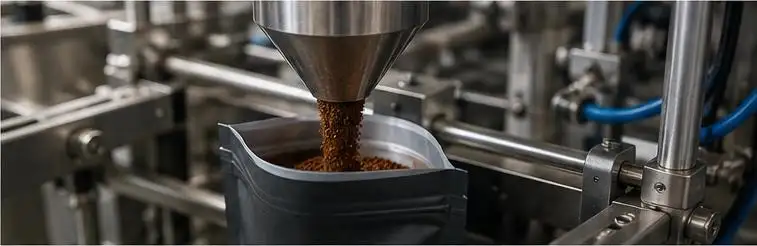
Ground coffee changes the filling process because fines can become airborne during dosing.
Increasing sealing temperature may not restore reliable seal integrity if coffee particles come in contact with the sealing interface. We start our review of the filling process.
Key Ground Coffee Control Points
•Position of filling nozzle: Adjust to keep the flow of powder away from the side walls of the upper pouch.
•Drop distance: A shorter distance controlled discharge of powder should minimize waste.
•Dust extraction: This should remove fine particles that accumulate around the dosing and sealing stations.
•Seal zone clearance: Keep seal zone clean and free from obstruction.
•Jaw condition: Seal bars must be clean, and parallel during sealing.
•Seal recipe: Temperature and pressure seals should be workable to the film structure.
Therefore, the design of ground coffee pouch for automatic filling calls for careful integration of pouch design, filler geometry, dust control and sealing.
Multihead Weigher or Auger Filler?
The pouch cannot be specified independently from the dosing system.
| System | Better Suited To | Main Engineering Concern |
| Multihead Weigher | Whole beans and granular coffee | Weight accuracy, drop path, product damage |
| Auger Filler | Ground coffee | Powder flow, dosing consistency, dust |
| Weight-Based Powder System | Some ground coffee applications | Accuracy vs production speed |
| Combined/Changeover Line | Multiple coffee SKUs | Recipe control and cleaning |
If one packaging line handles both whole beans and grounds, machine recipes should normally be revalidated during changeover. Dosing settings, fill height, dust extraction, sealing parameters, and even pouch opening behavior may need adjustment.
Film Structure Must Balance Barrier and Machine Runability
A high-barrier laminate is not automatically a good Coffee Pouch for Automatic Filling if it performs poorly on the packaging machine.
Automatic lines depend on several material properties working together:
Barrier Performance
OTR indicates oxygen transmission performance, while WVTR relates to moisture-vapor transmission. Targets should be defined according to shelf-life requirements and actual product conditions rather than assuming that a thicker film always delivers better protection.
Film Stiffness
Premade pouches need sufficient body to:
•Separate from the magazine
•Be gripped or vacuum-picked
•Open consistently
•Maintain shape during filling
A structure that is excessively soft or curled can create feeding problems even when its barrier properties are adequate.
Surface Friction
Coefficient of friction influences pouch feeding and movement through automated stations. Too much or too little friction can affect repeatability depending on machine design.
Sealability
A useful structure requires an adequate processing window for:
Temperature + Pressure + Dwell Time
Ground coffee makes this particularly important because small amounts of contamination can narrow the effective sealing window.
Cyan Pak supports customized materials, sizes, finishes, printing, zippers, and degassing-valve configurations, allowing the pouch structure to be developed around both shelf-life and production requirements.
Premade Pouch vs. VFFS Is a System Decision
| Premade Coffee Pouch | VFFS Rollstock |
| Bag is formed before filling | Bag is formed during packaging |
| Suitable for complex retail pouch formats | Efficient for continuous forming and filling |
| Dimensional tolerance is critical | Film tracking and forming behavior are critical |
| Zipper/valve can be integrated into pouch design | Features depend on line configuration |
| Pickup and opening must be validated | COF, registration and sealability require validation |
Neither approach is universally better. Selection should depend on the packaging machine, target output, required bag style, accessory configuration, SKU variety, and changeover strategy.
Final Words
At Cyan Pak, we approach a Coffee Pouch for Automatic Filling project as a packaging-and-process matching task rather than simply selecting a stock bag. By combining customized pouch formats, material structures, printing, closures, and degassing-valve options with the customer's filling requirements, the packaging specification can be validated more effectively before larger production runs. For a new whole-bean or ground-coffee project, sharing actual product and filling-line parameters is the most practical starting point for developing the right pouch.
FAQs
Q1. Does Cyan Pak offer coffee pouches that are system compatible?
Yes, Cyan Pak's coffee pouches can be customized based on pouch size and dimensions, material, and zipper or valve position and building line requirements.
Q2. Can Cyan Pak offer coffee and whole bean pouches that differ in size?
Yes, coffee and whole bean pouch sizes will vary along with filling gap, sealing, and valve position. Custom coffee pouch formats can be made to meet the requirements of whole bean, ground, or coffee.
Q3. What coffee pouch formats does Cyan Pak offer?
Cyan Pak offers coffee packaging formats that come in stand-up pouches, flat bottom bags, bags with side gussets, and quad seal bags, which allows customers the flexibility of choosing the best format based on the filling process, weight of pack, and the specific retail needs.
Q4. Can Cyan Pak coffee pouches contain valves for degassing coffee?
Yes, coffee packaging formats can be designed with valves for degassing provided the position of the valve is not in conflict with the filling and sealing equipment.
Q5. Can Cyan Pak coffee pouches have resealable closures?
Yes, zippers can be added to coffee pouches. For automatic filling of coffee, sufficient space for opening, filling, and sealing must be left.
Written by
Cyan Pak Coffee
At Cyan Pak Coffee, we provide professional coffee packaging solutions for roasters, cafés, and beverage brands. From design and printing to production and delivery, our team offers a full range of custom packaging services. Our products include coffee bags, boxes, takeaway cups, and other packaging accessories, all customizable in materials, sizes, and print finishes. Focusing on sustainability, innovative design, and low minimum orders, we help brands create unique and efficient packaging experiences.