


Updated 2 months ago
Compostable Flat Bottom Pouch Materials: PLA, PBAT, Cellulose and Kraft Explained
Cyan Pak Coffee
At Cyan Pak Coffee, we provide professional coffee packaging solutions for roasters, cafés, and beverage brands. From design and printing to production and delivery, our team offers a full range of custom packaging services. Our products include coffee bags, boxes, takeaway cups, and other packaging accessories, all customizable in materials, sizes, and print finishes. Focusing on sustainability, innovative design, and low minimum orders, we help brands create unique and efficient packaging experiences.

Compostable Flat Bottom Pouch
A Compostable Flat Bottom Pouch is not defined by one "reen" material. For coffee and dry-food packaging, the pouch must work as a complete engineering system: the outer layer provides stiffness and printability, the barrier layer controls oxygen and moisture, the sealant layer creates package integrity, and every component must be compatible with the intended composting route.
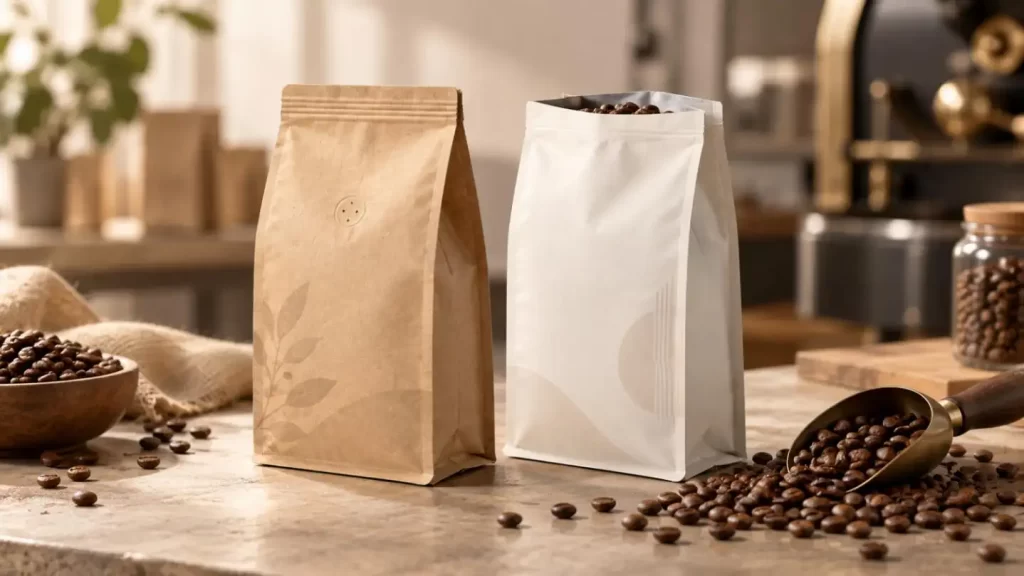
At Cyan Pak, we therefore approach Compostable Flat Bottom Pouch development from the packaged product backward—not by selecting PLA or Kraft first.
Why Material Selection Is More Difficult in a Flat Bottom Pouch
A flat bottom format places more mechanical demands on a laminate than a simple three-side-seal pouch. The material must withstand:
•Repeated folding around the bottom gusset;
•Stress concentration at side and bottom seals;
•Pouch opening during filling;
•Product load during transportation;
•Heat exposure at the sealing jaws;
•Valve and zipper installation where required.
Too much stiffness can increase cracking risk around folds. Too little stiffness can reduce shelf stability and make automatic pouch opening less consistent.
For that reason, a successful Compostable Flat Bottom Pouch requires a balance of stiffness, elongation, seal strength, puncture resistance and barrier performance.
What PLA, PBAT, Cellulose and Kraft Actually Contribute
PLA: Structure and Heat-Seal Function
PLA is commonly used in compostable flexible packaging, but it should not be treated as one universal film.
Depending on grade and film construction, PLA can contribute:
•Structural stiffness;
•Transparency;
•Print or lamination support;
•Grease and aroma resistance;
•Heat-sealing functionality.
For example, NatureWorks lists a seal initiation temperature of approximately 80°C for its Ingeo 4060D heat-seal grade. That figure applies to that specific resin—not to every PLA film.
This illustrates an important purchasing rule: never specify a Compostable Flat Bottom Pouch simply as "PLA." Film grade, thickness, layer position and sealing behavior all matter.
PBAT: Flexibility Where PLA May Be Too Rigid
PBAT is often blended into compostable polymer systems to improve flexibility and toughness. This can be useful around gussets and heavily folded areas.
PBAT also demonstrates why bio-based and compostable are different concepts. BASF describes its ecoflex PBAT as a fossil-based polymer that is nevertheless certified compostable.
In practical pouch engineering, a PLA/PBAT-type system can help balance:
PLA stiffness + PBAT flexibility → Improved forming and fold resistance
The exact formulation, however, must be validated rather than assumed.
Cellulose Film: High Gas Barrier, Grade-Dependent Moisture Barrier
Cellulose-based films can offer very good oxygen, gas and aroma barrier properties. They are therefore technically interesting for products such as coffee.
However, moisture performance varies significantly by grade and coating. Futamura, for example, offers cellulose films ranging from highly water-vapor-permeable base films to coated grades with enhanced moisture barrier.
That means a buyer should request actual WVTR and OTR data, including test temperature and relative humidity.
Kraft Paper: Structural Layer, Not the Complete Barrier
Kraft paper can provide:
•Stiffness;
•Natural tactile appearance;
•Printable surface;
•Support for flat-bottom geometry.
It does not normally provide all required oxygen, moisture and heat-seal functions on its own. A functional film or coating therefore becomes part of the complete Compostable Flat Bottom Pouch structure.
Comparing Practical Compostable Structures
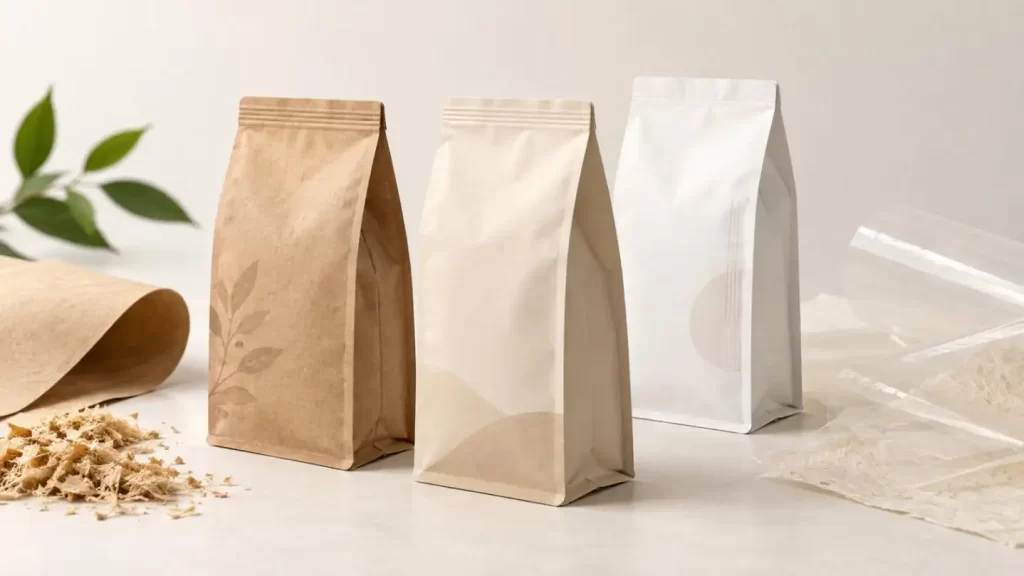
Cyan Pak currently lists several fully compostable structures for coffee packaging, including Kraft paper/PLA, Kraft paper/PLA/PLA and PLA/Kraft paper/PLA.
| Structure | Main Engineering Focus | Typical Question |
| Kraft/PLA | Simpler laminate | Is barrier and seal performance sufficient? |
| Kraft/PLA/PLA | Added functional layer | Does additional PLA improve sealing or protection? |
| PLA/Kraft/PLA | Encapsulated paper layer | Is the layer order better for surface and seal requirements? |
| PLA/PBAT system | Flexibility/toughness | Is more fold resistance required? |
| Cellulose-based laminate | Gas/aroma barrier | Is moisture protection adequate for the product? |
The correct Compostable Flat Bottom Pouch should therefore be selected by performance target, not by material name.
Barrier Performance Must Be Specified With Test Conditions
For coffee, tea and dry foods, two parameters are especially important:
•OTR — Oxygen Transmission Rate, generally reported in cc/m²/day;
•WVTR — Water Vapor Transmission Rate, generally reported in g/m²/day.
A lower value normally means stronger barrier performance, but numbers from different test conditions should not be compared directly.
Barrier performance depends on:
Material grade + Coating + Film thickness + Laminate structure + Temperature + Relative humidity
At Cyan Pak, we recommend defining the required shelf-life and product sensitivity first, then selecting the minimum structure capable of achieving the required protection.
Ground coffee, for example, generally requires closer oxygen management than products with lower exposed surface area, while powders or hygroscopic foods may place greater emphasis on moisture control.
Heat-Seal Performance Is a Window, Not a Single Temperature
Replacing conventional packaging with a Compostable Flat Bottom Pouch should include a filling and sealing trial.
Three parameters work together:
•Seal temperature;
•Dwell time;
•Seal pressure.
The objective is to establish a stable seal window rather than find one nominal temperature.
During production validation, we recommend checking:
•Top seal strength;
•Bottom and side-seal integrity;
•Gusset cracking;
•Zipper seal areas;
•Valve installation zones;
•Laminate delamination;
•Pouch feeding and opening consistency.
COF, film stiffness and pouch dimensions can also affect filling-line efficiency. Cyan Pak specifically considers seal temperature, hot tack, COF, stiffness, pouch dimensions, headspace and zipper/valve position when evaluating flat-bottom packaging performance.
Verify the Finished Pouch, Not Just the Resin
A compostable raw material does not automatically make the complete Compostable Flat Bottom Pouch certified compostable.
Under EN 13432-based certification, testing includes biodegradation, disintegration, ecotoxicity and heavy-metal content. TÜV Austria also notes that disintegration is affected by the material and the form of the final product, and its industrial compost certification covers components, inks and additives.
For North America, ASTM D6400-26 is the current active ASTM specification for plastics intended for municipal or industrial aerobic composting. BPI uses ASTM D6400 as the base standard for its commercial certification program.
Buyers should therefore verify the certificate against the actual pouch structure or applicable finished item, not simply accept a resin datasheet.
Cyan Pak Compostable Flat Bottom Pouch Specifications
Cyan Pak's current Flat Bottom Pouch platform supports:
•Capacity range: 10 g–10 kg;
•Custom Pantone or CMYK colors;
•Approximately 500–1,000 pouches per paper carton;
•Coffee, tea, powders and other dry-food applications.
Cyan Pak also operates with 10+ years of manufacturing experience, a 5,000+ m² production facility and an ISO 9001 quality management system, with support covering material selection, structure confirmation, printing and production planning.
Final Words
The most reliable solution is rarely "the most compostable-looking material." It is the structure that protects the product, runs consistently on the packing line and has a clearly verified end-of-life route.
For a new Compostable Flat Bottom Pouch project, Cyan Pak can help evaluate the material architecture, pouch size, printing, valve or zipper configuration and production requirements before sampling. This makes it easier to move from sustainability concept to a pouch that performs reliably in real packing and distribution conditions.
FAQs
Q1. What compostable material structures does Cyan Pak offer for flat bottom pouches?
Cyan Pak lists structures such as Kraft paper/PLA, Kraft paper/PLA/PLA and PLA/Kraft paper/PLA, depending on packaging requirements.
Q2. What sizes are available for a Cyan Pak Compostable Flat Bottom Pouch?
Cyan Pak’s Flat Bottom Pouch range supports approximately 10 g to 10 kg capacities, with dimensions customized to the product and fill volume.
Q3. Can Cyan Pak customize the printing on compostable flat bottom pouches?
Yes. Cyan Pak supports customized printing with Pantone and CMYK color systems for branded packaging.
Q4. Can Cyan Pak produce Compostable Flat Bottom Pouches for coffee?
Yes. The format can be developed for whole-bean coffee, ground coffee and other dry products, with structure selected according to barrier and sealing requirements.
Q5. Can a degassing valve be added to a Compostable Flat Bottom Pouch?
Valve options can be considered for coffee packaging, but buyers should confirm the valve material and compostability requirements for the complete finished pouch.
Written by
Cyan Pak Coffee
At Cyan Pak Coffee, we provide professional coffee packaging solutions for roasters, cafés, and beverage brands. From design and printing to production and delivery, our team offers a full range of custom packaging services. Our products include coffee bags, boxes, takeaway cups, and other packaging accessories, all customizable in materials, sizes, and print finishes. Focusing on sustainability, innovative design, and low minimum orders, we help brands create unique and efficient packaging experiences.
Related Articles

Large Capacity Coffee Packaging: Match Bulk Packs to Handling and Customer Needs

Coffee Packaging for Retail Display: Match Your Pack to How Customers Shop

Sustainable Coffee Packaging Bags: Create a Coordinated Packaging Range