

Updated 2 months ago
Eco Friendly Flat Bottom Coffee Bags: From Looks to Performance
Cyan Pak Coffee
At Cyan Pak Coffee, we provide professional coffee packaging solutions for roasters, cafés, and beverage brands. From design and printing to production and delivery, our team offers a full range of custom packaging services. Our products include coffee bags, boxes, takeaway cups, and other packaging accessories, all customizable in materials, sizes, and print finishes. Focusing on sustainability, innovative design, and low minimum orders, we help brands create unique and efficient packaging experiences.

Eco Friendly Flat Bottom Coffee Bags
For a coffee brand, packaging has two jobs: it must sell the product before opening and protect the coffee after filling. That is why Eco Friendly Flat Bottom Coffee Bags should never be specified on appearance alone.
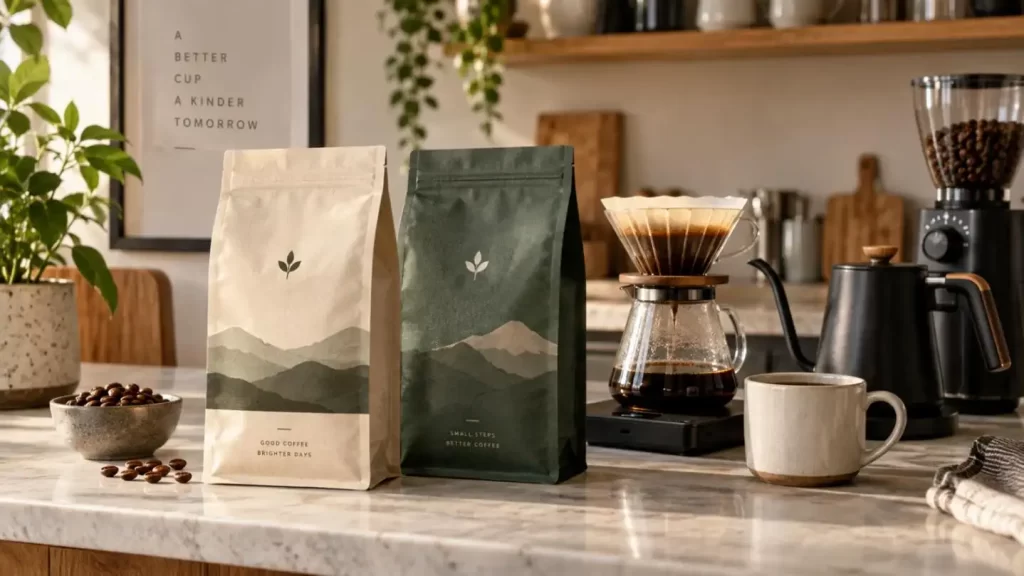
At Cyan Pak, we treat flat-bottom coffee packaging as a complete system. The outer surface carries the brand; the laminate controls oxygen and moisture; the bottom structure supports shelf stability; the valve manages CO₂; the closure affects consumer use; and the printing process determines whether the artwork can be reproduced consistently at scale.
The best Eco Friendly Flat Bottom Coffee Bags are therefore designed around both brand presentation and packaging performance.
Flat-Bottom Geometry Is Part of the Brand Design
A flat-bottom pouch provides more than a premium shape. Its geometry creates a stable retail footprint and several usable communication surfaces.
A typical design can use:
• The front panel for logo, coffee name and origin;
• The side gussets for tasting notes, brewing instructions or brand story;
• The back panel for traceability, certifications and preparation information;
• The flat base to improve standing stability on retail shelves.
This gives Eco Friendly Flat Bottom Coffee Bags a clear advantage when a brand needs strong shelf presence without using rigid packaging.
However, the structure must remain stable after filling. A pouch that looks clean when empty may bulge, twist or crease once loaded with 500 g or 1 kg of coffee.
For this reason, artwork development should happen alongside pouch engineering rather than after the bag structure has already been fixed.
Material Choice Affects Both Appearance and Product Protection
Sustainable packaging materials are not visually or technically interchangeable.
At Cyan Pak, material selection starts with three questions:
- What visual identity does the brand want?
- What barrier does the coffee require?
- What end-of-life route is being targeted?
| Material Direction | Visual Character | Key Technical Consideration |
| Recyclable PE | Clean, modern | Barrier, stiffness and sealability must be engineered |
| Kraft-based laminate | Natural, tactile | Functional inner layers may still be required |
| Rice paper structure | Lightweight, distinctive | Mechanical strength and barrier need validation |
| PLA-based structure | Sustainability-led appearance | Composting conditions and market infrastructure matter |
A kraft surface, for example, may communicate "natural" or "craft," but the paper itself does not determine coffee shelf life. The inner structure still has to control oxygen, moisture and seal integrity.
That is why Eco Friendly Flat Bottom Coffee Bags should be selected as a laminate system rather than by surface appearance alone.
High-Barrier Performance Still Matters
Roasted coffee is sensitive to oxygen and moisture, while freshly roasted beans continue to release carbon dioxide.
A functional coffee pouch must manage four different factors:
| Packaging Challenge | Required Response |
| Oxygen ingress | Low-OTR barrier structure |
| Moisture transmission | Controlled WVTR |
| CO₂ release | One-way degassing valve |
| Seal leakage | Stable heat-seal system |
OTR and WVTR should be evaluated together with film thickness, temperature and relative humidity. A supplier describing a film simply as "high barrier" without test conditions is not providing enough information for a technical comparison.
For Eco Friendly Flat Bottom Coffee Bags, barrier specification should start with the intended shelf life, coffee type and distribution environment.
Whole beans, ground coffee, short-cycle subscription products and export coffee may require different protection levels even when the external bag design looks identical.
Bag Size Should Drive the Structure
One common mistake is scaling the artwork from a 250 g bag to a 1 kg bag while keeping the same material specification.
Larger bags experience higher mechanical loads at:
• Bottom gussets;
• Side seals;
• Zipper intersections;
• Top seals;
• Valve areas.
Cyan Pak's flat-bottom coffee packaging can be produced in common capacities including 250 g, 500 g and 1 kg, with custom sizing available. Typical customizable thickness ranges for recyclable flat-bottom formats are approximately 100–150 μm, depending on structure and application.
The practical design sequence should be:
Fill weight → Dimensions → Film stiffness → Thickness → Seal strength → Final pouch stability
rather than choosing thickness first.
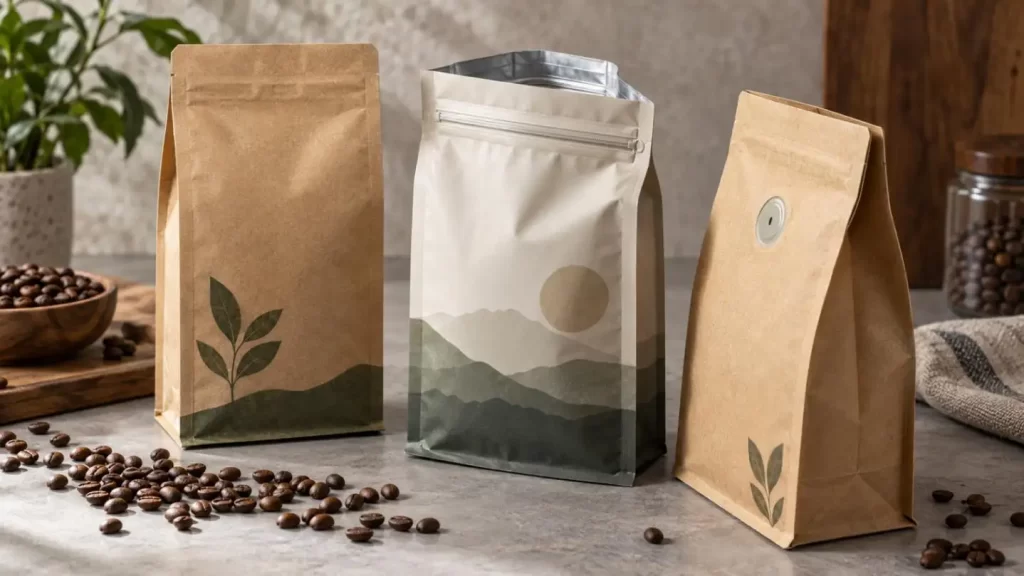
The Degassing Valve Must Be Designed Into the Artwork
For freshly roasted coffee, a one-way valve is often a functional necessity rather than an accessory.
Its role is to allow CO₂ generated by roasted coffee to leave the pouch while limiting oxygen ingress.
But valve placement also affects the visual layout of Eco Friendly Flat Bottom Coffee Bags.
When we develop a pouch, valve position should be checked against:
• Logo placement;
• Zipper location;
• Filling height;
• Top-seal area;
• Available headspace;
• Automatic valve application equipment.
A valve placed correctly on an empty dieline can still end up too close to the coffee fill line once the pouch is filled.
For that reason, final valve positioning is best evaluated using the actual bag dimensions and target fill weight.
Closure Design Shapes the Consumer Experience
The visual experience ends when the customer opens the bag. After that, the closure becomes part of the brand experience.
Common options include:
• Zipper for frequent reopening;
• Tin tie for a traditional or craft presentation;
• Heat seal for secure initial closure;
• Tear notch for easier first opening.
The right closure should match both the product and the package geometry.
For example, a zipper requires sufficient headspace and must not interfere with the top seal. On larger Eco Friendly Flat Bottom Coffee Bags, zipper strength and seal consistency become more important because consumers may open and close the bag many times.
Printing Technology Should Match the SKU Strategy
A high-quality design can still become inefficient if the wrong printing process is selected.
Cyan Pak supports both digital and gravure printing, with options for up to 10 colors and finishes including matte, gloss and natural kraft texture.
Digital Printing Is Often Better For:
• Low-to-medium quantities;
• Multiple coffee origins;
• Seasonal editions;
• Frequent artwork changes;
• Market testing.
Gravure printing is often better for:
• Larger repeat orders;
• Stable artwork;
• Long-running SKUs;
• Consistent high-volume production.
The purchasing decision should include setup cost, SKU count, inventory exposure and artwork-change frequency—not just unit price.
A Practical Approval Checklist
Before approving production, we recommend confirming:
• Coffee type: whole bean or ground;
• Target shelf life;
• Fill weight and pouch dimensions;
• Material and barrier structure;
• OTR and WVTR requirements;
• Valve type and position;
• Closure system;
• Film thickness;
• Printing method;
• Seal performance;
• Sustainability claim and supporting evidence.
From Attractive Packaging to Reliable Packaging
The strongest Eco Friendly Flat Bottom Coffee Bags achieve four things at the same time:
Attract → Protect → Function → Communicate
They attract attention, protect the coffee, work correctly in real use and communicate the brand clearly.
At Cyan Pak, we design coffee packaging around that balance rather than treating sustainability, appearance and performance as separate decisions. Brands evaluating recyclable PE, kraft, rice paper, PLA-based structures, degassing valves or resealable formats can explore our Eco Coffee Bag range to compare available options and develop a specification around the actual product.
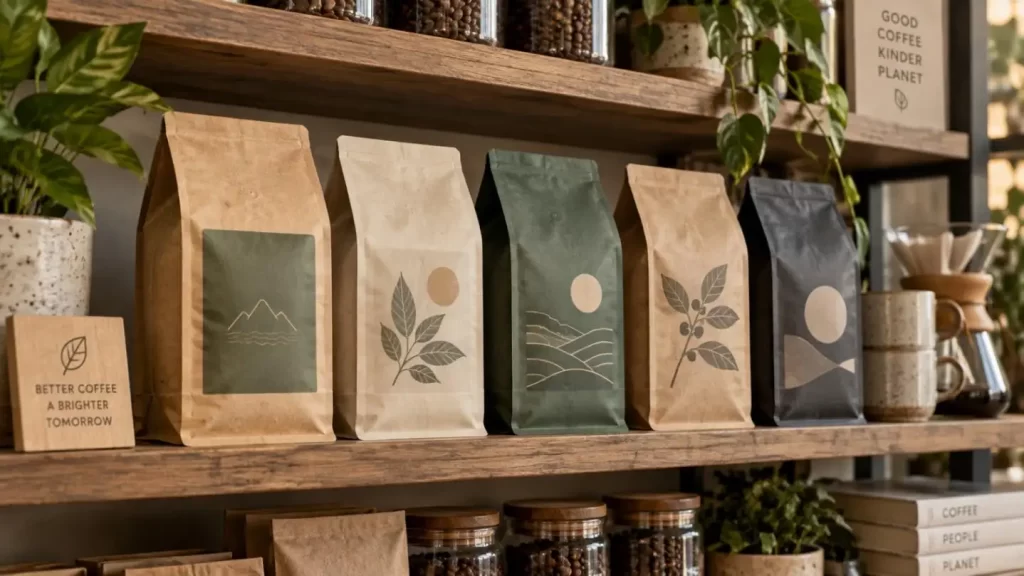
Explore the Cyan Pak Eco Coffee Bag range to see how material, structure, printing and functional features can be combined in Eco Friendly Flat Bottom Coffee Bags.
FAQs
Q1. What eco-friendly materials does Cyan Pak offer for coffee bags?
Cyan Pak offers recyclable LDPE, kraft paper, rice paper, and PLA-based packaging options, allowing brands to select materials based on appearance, barrier needs, and end-of-life goals.
Q2. Are Cyan Pak Eco Friendly Flat Bottom Coffee Bags suitable for whole beans and ground coffee?
Yes. Cyan Pak produces coffee packaging for both roasted whole beans and ground coffee, with barrier and valve options selected according to the product and storage requirements.
Q3. What sizes are available?
Common Cyan Pak coffee bag capacities include 100 g, 250 g, 500 g, and 1 kg, with custom dimensions available for specific filling and branding requirements.
Q4. What thickness can Cyan Pak coffee bags be produced in?
Many Cyan Pak coffee bag formats are available in approximately 100–150 micron customizable thicknesses, depending on material structure, bag size, and application.
Q5. Can Cyan Pak add a one-way degassing valve?
Yes. Cyan Pak offers one-way degassing valves designed to release CO₂ from freshly roasted coffee while helping limit oxygen entry into the bag.
Written by
Cyan Pak Coffee
At Cyan Pak Coffee, we provide professional coffee packaging solutions for roasters, cafés, and beverage brands. From design and printing to production and delivery, our team offers a full range of custom packaging services. Our products include coffee bags, boxes, takeaway cups, and other packaging accessories, all customizable in materials, sizes, and print finishes. Focusing on sustainability, innovative design, and low minimum orders, we help brands create unique and efficient packaging experiences.
Related Articles

Large Capacity Coffee Packaging: Match Bulk Packs to Handling and Customer Needs

Coffee Packaging for Retail Display: Match Your Pack to How Customers Shop

Sustainable Coffee Packaging Bags: Create a Coordinated Packaging Range