


Updated 3 weeks ago
Flat Bottom Pouch Supplier for Recyclable and Sustainable Packaging
Cyan Pak Coffee
At Cyan Pak Coffee, we provide professional coffee packaging solutions for roasters, cafés, and beverage brands. From design and printing to production and delivery, our team offers a full range of custom packaging services. Our products include coffee bags, boxes, takeaway cups, and other packaging accessories, all customizable in materials, sizes, and print finishes. Focusing on sustainability, innovative design, and low minimum orders, we help brands create unique and efficient packaging experiences.

Flat Bottom Pouch Supplier
The decision to change to "sustainable" flat bottom pouch packaging is not simply about replacing the traditional plastic pouch with one that looks and seems "more" environmentally friendly. Sustainable packaging for coffee roasters and food companies means considering how the packaging will impact the environment at various stages – from material sourcing, protection of the product and prevention of food waste, and how the packaging can support easy and efficient production while serving its end-of-life function.
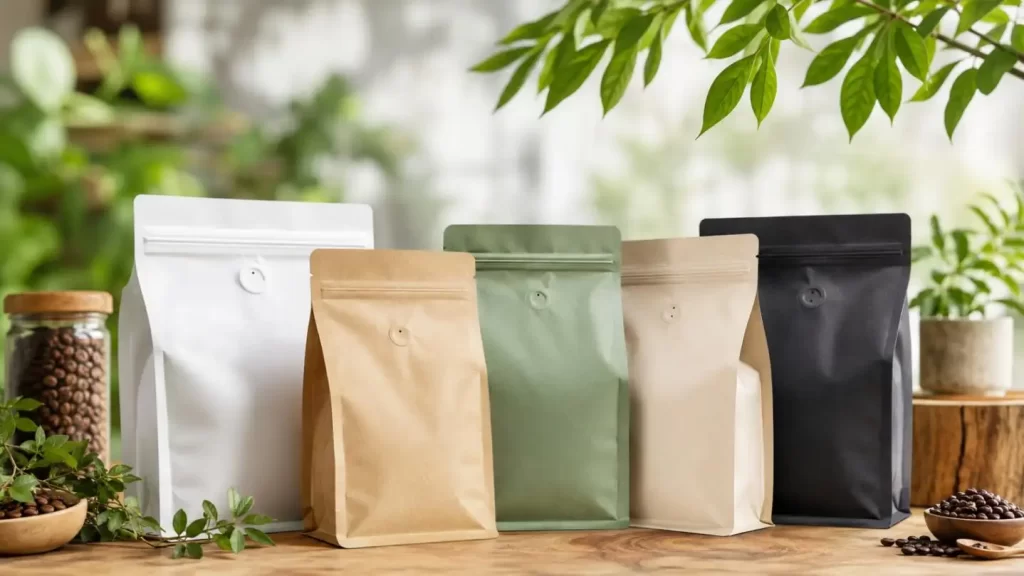
At Cyan Pak, we offer multiple sustainable packaging options focused around optimal structure, material, and design, as well as production and manufacturing. These options consider balanced sustainability and real performance outcomes for packaging.
Sustainable Packaging Starts With the Whole Packaging System
A sustainable flat bottom pouch should be assessed across its entire life cycle, not by one material claim.
For a Flat Bottom Pouch Supplier, the key assessment criteria include:
• Packaging reduction
• Reusable packaging design
• If the packaging still ensures the protection of the product for the specified shelf life.
• Does the zipper, valve, ink, adhesive, etc., support the sustainability strategy?
• Can the design easily accommodate existing filling equipment?
• A viable recycling or disposal system exists for the target market.
This involves the product protection shelf life, as well as the recyclability, material efficiency and the manufacturing process.
Material Reduction Is More Than Making the Film Thinner
Lightweighting is one of the most direct ways to reduce packaging material, but simply reducing film thickness can create new problems.
A thinner pouch may use less resin, yet insufficient mechanical strength can lead to:
• Punctures during transport
• Poor gusset stability
• Weak seals
• Reduced shelf presence
• Higher leakage rates
• Increased product loss
A professional Flat Bottom Pouch Supplier should therefore compare packaging weight with functional performance.
The better approach is:
Reduce unnecessary material → maintain required strength → validate filling and transport performance
At Cyan Pak, material structures and pouch dimensions can be adjusted around actual product weight, bulk density, distribution conditions, and required barrier level instead of simply specifying the thickest available laminate.
Recyclable Packaging Requires Structure Simplification
One of the most important sustainable packaging trends is moving from complex multi-material laminates toward structures designed for established recycling streams.
Recyclable LDPE Structures
Recyclable LDPE-based packaging can help simplify the material structure compared with some conventional multilayer laminates.
However, buyers still need to verify:
•Oxygen barrier
•Moisture barrier
•Heat-sealing performance
•Film stiffness
•Zipper compatibility
•Valve compatibility
•Printing and coating structure
Cyan Pak offers recyclable LDPE packaging options for brands looking to develop more recycling-oriented flexible packaging.
Conventional Multilayer Laminates
Traditional PET/PE, metallized, or foil-based structures can offer strong barrier and mechanical performance, but their combination of different materials can make recycling more complex.
The role of a Flat Bottom Pouch Supplier is therefore not to label one structure as universally sustainable, but to determine whether a simplified recyclable structure can meet the actual product requirements.
| Packaging Direction | Sustainability Advantage | Key Technical Consideration |
| Recyclable LDPE | Simplified material stream | Barrier and stiffness |
| Lightweight Laminate | Reduced material use | Mechanical strength |
| Kraft / Paper-Based | Renewable-material content and appearance | Inner barrier structure |
| PLA / Plant-Based Film | Renewable material route | End-of-life conditions |
| Conventional High Barrier | Strong shelf-life protection | More complex recycling |
Product Protection Is Part of Sustainable Packaging
Sustainable packaging should not reduce material use at the cost of higher product waste.
The shelf stability of coffee, nuts, and powdered products can decrease due to the oxidation of materials and moisture absorption. Both OTR (oxygen transmission rate) and WVTR (water vapor transmission rate) must be accounted for in order to achieve sustainability in packaging.
• OTR: Used to gauge the performance of an oxygen barrier.
• WVTR: Used to gauge the performance of a barrier to water vapor.
A Flat Bottom Pouch Supplier should evaluate how an oxygen and moisture barrier relates to the packaged product and recommend the appropriate barrier instead of using either a maximum barrier or minimum material.
An unnecessarily complex foil laminate for a short distribution cycle results in overpackaging. Selecting too weak of an oxygen and moisture barrier for export coffee results in loss of aroma and an increase in waste.
Sustainable packaging is therefore about right-sizing barrier performance, not simply reducing it.
Zippers and Degassing Valves Also Affect Sustainability
Flat bottom pouches are packaging systems rather than single films.
A typical coffee pouch may include:
• Main film
• Resealable zipper
• One-way degassing valve
• Printing ink
• Adhesive
• Barrier coating
• Sealant layer
If the pouch body is designed for recycling but the other components are incompatible with the intended recycling stream, the sustainability benefit may be reduced.
Cyan Pak provides recyclable degassing valve options and different resealable closure systems alongside recyclable and conventional pouch structures. This allows the complete package to be considered during development rather than treating accessories as an afterthought.
Paper and Plant-Based Materials Require the Same Evaluation
Kraft paper, rice paper, and PLA are just a few examples of plant-based materials that are used in eco-friendly packaging. While their eco-friendly attributes are clear, they still require a proper technical assessment.
• Integrated Material Structure: Sustainable packaging is a combination of multiple materials including paper, plant-based materials, sealants, coatings, adhesives, and many others.
• Internal Barrier Layer: Paper-based packaging normally loses a lot of its protective qualities resulting in moisture, grease, and odor loss as well, unless it is covered by a plastic film, coating, or barrier layer.
• End of Life option: Determining a proper end of life option (recycle, compost, or dispose of) for an entire packaging structure affects the marketability of your sustainable packaging solution.
• Disposal and Conditions of Composting: While PLA may be fully compostable, its end of life option and composting may need to be managed by the market destination infrastructure.
• Oxygen and Moisture Barrier: Like traditional packaging, sustainable packaging, to protect coffee, nuts, and other sensitive materials, needs to have proper OTR and WVTR barrier.
• Compatibility of Sealing: Kraft paper and plant based materials must have sealing performances in the acceptable temperature, pressure, and time ranges of existing sealing machines.
By offering a variety of options for sustainable packaging using kraft paper, PLA, rice paper, and plant based, as well as LDPE, Cyan Pak allows brands to choose the best solution to fit their needs rather than offering a default solution.
Sustainable Packaging Must Run Efficiently on the Filling Line
Production Efficiency is Another Part of Sustainability
If a new pouch causes frequent machine stops, high rejection rates, or poor seals, the resulting material and product waste can offset part of the benefit gained through material changes.
A Flat Bottom Pouch Supplier should therefore verify:
| Production Factor | Sustainability Impact |
| Seal Temperature | Prevents weak or overheated seals |
| Hot Tack | Reduces seal failures after filling |
| COF | Supports stable machine feeding |
| Film Stiffness | Improves pouch opening |
| Pouch Dimensions | Prevents unnecessary material use |
| Filling Headspace | Avoids oversized packaging |
| Zipper/Valve Position | Reduces processing interference |
Pouch sizing should also reflect product bulk density. A properly sized pouch reduces unnecessary film area, carton volume, and transportation space.
Final Words
At Cyan Pak, sustainable packaging projects can be developed around the product, shelf-life target, destination market, filling process, and environmental objective. By combining recyclable LDPE, plant-based films, paper-based formats, closure options, and practical manufacturing support, we help brands move from general sustainability goals to packaging specifications that can actually be produced and used reliably.
For brands evaluating a new Flat Bottom Pouch Supplier, the next step is to define the sustainability target first—whether that means recyclability, material reduction, renewable materials, or a combination of these goals. Cyan Pak can then help translate that target into a practical flat bottom pouch structure suitable for sampling and production.
FAQs
Q1. What are Cyan Pak’s options for sustainable flat bottom pouch materials?
Cyan Pak has LDPE, paper based structures, plant based films, and standard high barrier laminates for different packaging applications.
Q2. Can Cyan Pak produce recyclable flat bottom pouches?
We can produce recyclable flat bottom pouches based upon required barrier, sealing and end market conditions involving LDPE structures.
Q3. Does Cyan Pak offer sustainable packaging for coffee?
We do offer sustainable solutions for coffee pouch packaging and we can supply resealable packaging solutions with degassing valves for coffee packaging.
Q4. Does Cyan Pak offer pouch packaging materials with a reduction in packaging material?
Yes, we can reduce packaging material by optimizing dimensions of pouches and film structures, reducing film thickness, and reducing gusset and headspace structures.
Q5. Does Cyan Pak offer recyclable degassing valves?
Recyclable degassing valves are available for coffee packaging with an emphasis on developing a more recyclable pouch structure.
Written by
Cyan Pak Coffee
At Cyan Pak Coffee, we provide professional coffee packaging solutions for roasters, cafés, and beverage brands. From design and printing to production and delivery, our team offers a full range of custom packaging services. Our products include coffee bags, boxes, takeaway cups, and other packaging accessories, all customizable in materials, sizes, and print finishes. Focusing on sustainability, innovative design, and low minimum orders, we help brands create unique and efficient packaging experiences.